Solar Warranty in Ghana: What Every Buyer Must Check Before Installation

A solar warranty in Ghana can look reassuring on a quotation.

Five years.

Ten years.

Twenty-five years.

But the number alone tells you almost nothing.

Customers often assume that one long warranty covers the entire solar system, all labour, every service visit and any loss of performance. In reality, a solar installation may contain several different warranties issued by different organisations under different conditions.

A panel manufacturer may cover one type of failure. A battery manufacturer may impose operating and registration conditions. The installer may provide a separate workmanship warranty. Transport, diagnosis, removal and reinstallation may or may not be included.

The most important warranty question is therefore not:

“How many years?”

It is:

“What exactly is covered, by whom, under what conditions and at whose cost?”

The five warranties customers commonly confuse

A complete solar power system can contain several forms of cover.

1. Solar-panel product warranty

This generally relates to defects in materials or manufacturing during a stated period.

It may address issues such as premature component failure, depending on the manufacturer’s terms.

It does not automatically mean the panel is guaranteed to produce its original output for the full period.

2. Solar-panel performance warranty

This normally describes the manufacturer’s commitment that panel output will not fall below a specified percentage over time, subject to the warranty conditions.

A performance warranty is different from a product warranty.

A panel may still operate while producing less energy than expected because of shading, dirt, wiring, inverter settings, design error or site conditions. Those issues may not be panel-manufacturer defects.

3. Inverter warranty

The inverter manufacturer may cover defined equipment faults for a specified period.

Coverage can depend on:

  • Correct installation
  • Approved operating conditions
  • Proper commissioning
  • Serial-number records
  • Product registration
  • Firmware or configuration requirements
  • Excluded causes such as misuse or external damage

The customer should know whether the local installer, distributor or manufacturer handles the claim.

4. Battery warranty

Battery warranties can be more complex than customers expect.

Terms may consider:

  • Years in service
  • Energy throughput
  • Cycle count
  • Remaining capacity
  • Temperature limits
  • Depth of discharge
  • Compatible inverter operation
  • Communication with the battery management system
  • Installation and registration requirements

A battery warranty is not simply a promise that the battery will perform like new until the final day.

5. Installer workmanship warranty

This covers defined installation defects for which the installer is responsible.

It may relate to workmanship involving:

  • Cable termination
  • Mounting
  • Equipment installation
  • Configuration
  • Labelling
  • Integration

The exact scope should be written clearly.

A workmanship warranty does not replace the equipment manufacturer’s warranty, and an equipment warranty does not excuse poor workmanship.

A long warranty from a disappearing installer has little value

This is the uncomfortable truth.

A 10-year workmanship warranty from a company that closes after three years has effectively become a three-year warranty.

Solar businesses sometimes fail because they price installations too low to support future obligations. The company completes many projects on thin margins, promises long warranties and later becomes overwhelmed by service calls, transport costs, labour and replacement work.

Customers then call a new installer to diagnose a system they did not design.

That new company must spend time identifying equipment, tracing wiring, checking configuration and separating installation faults from product faults.

The customer may pay again simply to discover what is wrong.

This is why the financial and operational stability of the installer matters.

You are not only buying equipment. You are buying the probability that competent help will still exist when you need it.

What a solar warranty may not cover

Warranty exclusions vary, but customers should ask about issues such as:

  • Physical damage
  • Lightning or external electrical surges
  • Flooding, fire or extreme environmental exposure
  • Unauthorised modification
  • Installation by an unapproved person
  • Operation outside specified limits
  • Poor maintenance
  • Internet or communication failure
  • Damage from the existing electrical installation
  • Generator or grid-quality problems
  • Consumable items
  • Transport and travel
  • Labour for removal and replacement
  • Loss of income or business interruption

Do not assume. Read the actual terms.

If the quotation says “10-year warranty” but no warranty document is available, the claim is incomplete.

Ask who pays for diagnosis

When a solar system stops performing, the cause is not always obvious.

Possible causes include:

  • Equipment failure
  • Loose or damaged connections
  • Incorrect settings
  • Changed customer loads
  • Shading or dirt
  • Communication problems
  • Grid or generator conditions
  • Battery operating limits
  • Tripped protection
  • External damage

Diagnosis requires time, tools and expertise.

Ask:

  • Is remote diagnosis included?
  • Is a site visit free during the warranty period?
  • Who pays transport to a remote location?
  • Is labour included if the manufacturer accepts the claim?
  • Who pays if no product defect is found?
  • Is there a defined response process?

Clear answers prevent conflict later.

Product replacement does not always mean free system restoration

A manufacturer may approve replacement of a defective component.

But several other tasks may still be required:

  1. Diagnose the fault.
  2. Remove the equipment.
  3. Package and transport it.
  4. Submit documentation.
  5. Wait for assessment or replacement.
  6. Install the replacement.
  7. Reconfigure the system.
  8. Test and recommission it.

Find out which party is responsible for each stage.

A customer may receive a replacement product but still face labour and logistics costs if those items are excluded.

Documentation protects your warranty

A professional handover should leave the customer with useful records.

Depending on the system, these may include:

  • Final quotation and contract
  • Equipment make, model and serial numbers
  • Manufacturer warranty documents
  • Installer workmanship warranty
  • Invoices and proof of purchase
  • System diagram or equipment schedule
  • Configuration records
  • Commissioning report
  • Monitoring access
  • Product-registration confirmation
  • Maintenance instructions
  • Contact and escalation procedure

Do not leave warranty evidence only inside the installer’s phone or email account.

The customer should possess copies.

Register equipment when required

Some manufacturers or distributors require product registration within a defined period or request specific information when a claim is made.

Ask the installer:

  • Does any equipment require registration?
  • Who completes it?
  • Whose email address is used?
  • Will the customer receive confirmation?
  • Does an extended warranty require additional action or payment?

The system owner should not discover an uncompleted registration only after equipment fails.

Maintenance and warranty are connected

A warranty does not eliminate the need for maintenance.

Solar systems should be inspected according to the equipment, site and operating conditions. Maintenance may involve:

  • Visual inspection
  • Cleaning where necessary
  • Checking for physical damage
  • Reviewing alarms and monitoring data
  • Checking ventilation and environmental conditions
  • Verifying connections and protection through competent personnel
  • Updating records after changes

Do not allow unqualified people to open or modify electrical equipment simply because they call the activity “maintenance.” Unauthorised work may create new hazards and affect warranty claims.

Questions to ask about a solar warranty in Ghana

Before signing, ask:

  1. What warranty applies to each panel, inverter, battery and major accessory?
  2. Is the period a product warranty, performance warranty or workmanship warranty?
  3. Who issued each warranty?
  4. Who receives and manages a claim in Ghana?
  5. Is the equipment sourced through an authorised channel?
  6. Is product registration required?
  7. Are diagnosis, labour and transport included?
  8. What exclusions apply?
  9. What maintenance is required?
  10. What happens if the original installer is unavailable?
  11. Will Nocheski or another local technical partner retain system records?
  12. What documents will the customer receive at handover?

Do not accept “everything is covered” as an answer.

Red flags in warranty promises

Be cautious when:

  • The warranty period is stated but no terms are available.
  • The installer cannot identify the local warranty channel.
  • The equipment has no traceable model or serial information.
  • The warranty supposedly covers everything without exclusions.
  • The installer says the manufacturer’s warranty automatically covers labour.
  • The company has no visible technical support structure.
  • The quotation promises a very long workmanship warranty from a new or informal operation without explaining how support will be funded.
  • The customer is discouraged from keeping documentation or monitoring access.

Professional companies should make warranty responsibilities clearer, not more mysterious.
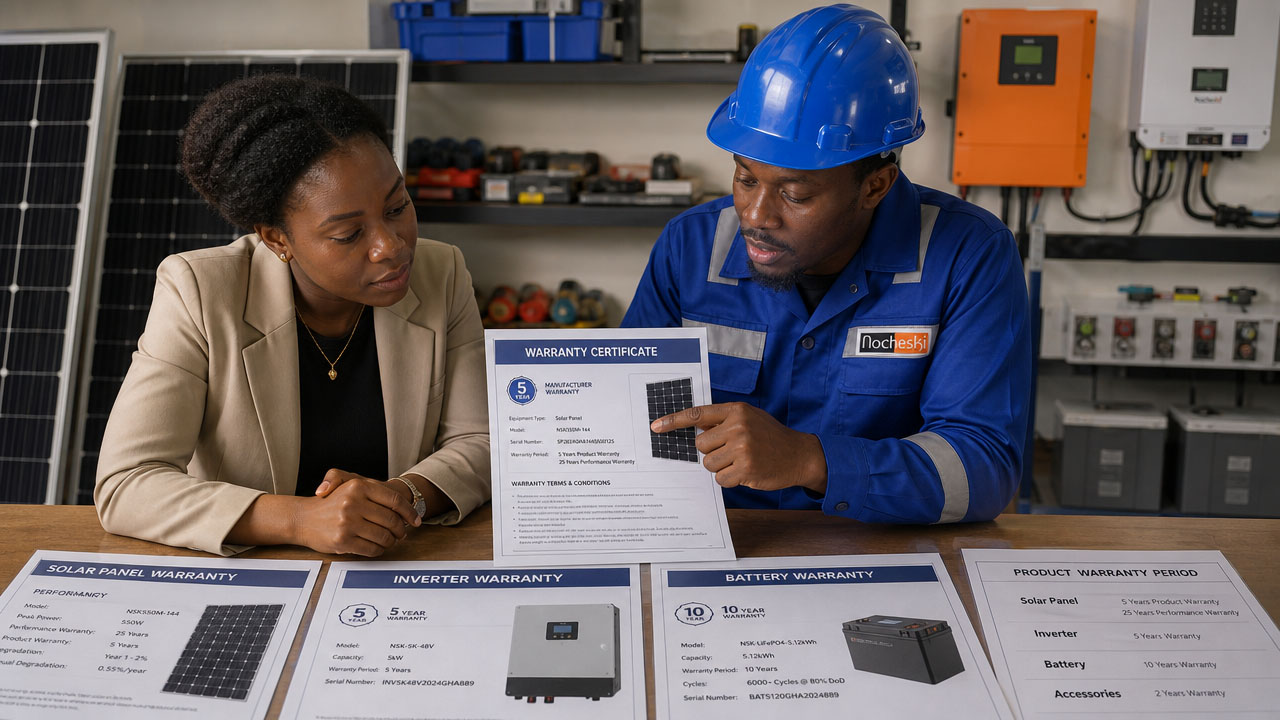
Nocheski Solar engineer reviewing solar equipment warranty documents.jpg
A 10-year solar warranty is only useful when you know what it covers, who honours it and what happens when equipment or workmanship fails.

How Nocheski Solar customers should evaluate warranty value

Warranty value comes from the combination of:

  • Reputable equipment
  • Correct design
  • Professional installation
  • Traceable supply channels
  • Accurate documentation
  • Proper commissioning
  • Responsible operation
  • Accessible technical support

The strongest warranty is the one you are least likely to need because the system was designed and installed correctly—and the one that can still be honoured if a genuine defect occurs.

Frequently asked questions

Is a 25-year solar-panel warranty the same as a 25-year complete-system warranty?

No. A long panel performance warranty does not automatically cover the inverter, battery, labour, wiring or installation workmanship.

Does a battery warranty guarantee full capacity for the entire period?

Usually not. Battery warranties have specific performance thresholds, operating limits and conditions. Read the manufacturer’s terms for the exact product.

Who should handle a solar warranty claim in Ghana?

That depends on the supply chain and contract. The customer should establish before purchase whether the installer, local distributor or manufacturer will manage the claim.

Does warranty cover lightning damage?

Do not assume it does. External electrical events and surge damage are commonly subject to exclusions or separate conditions. Appropriate system protection and insurance should be discussed.

Final advice

Do not be seduced by the largest warranty number on a quotation.

Ask for clarity.

A trustworthy installer should explain what is covered, what is not covered and what the customer must do to preserve warranty rights.

The warranty should be part of the engineering and commercial decision, not a marketing line added at the bottom of the page.

Choose a solar company built for long-term support

Nocheski Solar supplies and supports solar, inverter, battery-storage and electrical solutions across Ghana and West Africa.

Read our guide to choosing a solar installation company in Ghana, explore our product catalogue, or contact the technical team to discuss equipment, installation and support requirements.

A warranty is only as useful as its terms, documentation and the organisation standing behind it.


How to Compare Solar Quotations in Ghana Without Making an Expensive Mistake

Knowing how to compare solar quotations in Ghana is more difficult than comparing ordinary products.

The lowest figure is easy to identify. The best value is not.

Two proposals may both promise solar panels, an inverter, lithium battery storage and installation. Yet one may be a carefully engineered solution and the other may be an equipment list built to win on price.

If you compare only the total amount, you are not comparing like with like.

A professional solar quotation should help you understand what the system is designed to do, how it will do it, what is included and who remains responsible after installation.

This guide explains how homeowners, businesses, institutions and procurement teams can compare proposals more intelligently.

Step 1: Confirm that every installer is solving the same problem

Before comparing equipment, compare the design brief.

Did every company receive the same information about:

  • Monthly electricity consumption
  • Daytime and night-time loads
  • Critical appliances and equipment
  • Required backup duration
  • Peak demand
  • Motors, pumps, compressors or air-conditioners
  • Existing grid and generator supply
  • Roof or ground space
  • Future expansion
  • Budget constraints

If one installer assessed the site and another simply priced a standard package through WhatsApp, the quotations are not based on the same level of knowledge.

A very low quote may be lower because the installer has not understood the requirement.

Step 2: Compare total solar-array capacity, not panel count

“Ten panels” is not a useful comparison unless the panels have the same wattage and technology.

Ten 450-watt modules provide 4.5 kWp of nominal array capacity.

Ten 610-watt modules provide 6.1 kWp.

That is a major difference.

Compare:

  • Manufacturer and model
  • Wattage per panel
  • Number of panels
  • Total installed kWp
  • Module technology
  • Product warranty
  • Performance warranty
  • Suitability for the mounting arrangement

Nocheski Solar’s guide to solar-panel technology in Ghana explains why panel technology, efficiency, temperature behaviour and site conditions matter.

Do not assume the highest wattage panel is automatically the best choice. Layout, voltage design, inverter compatibility and available space must also be considered.

Step 3: Compare inverter capability, not only kVA

Customers often compare inverters using one number: kVA.

That is incomplete.

Check:

  • Manufacturer and exact model
  • Continuous power rating
  • Relationship between kVA and kW
  • Surge capability
  • Single-phase or three-phase architecture
  • Battery voltage
  • Number and limits of solar MPPT inputs
  • Grid, generator and off-grid capability
  • Parallel or expansion options
  • Monitoring features
  • Warranty and local support

A large number printed on the enclosure does not prove that the inverter can power every appliance simultaneously.

The installer should understand your peak load, starting currents and operating priorities.

Step 4: Compare usable battery energy, not only advertised capacity

Battery comparison is one of the easiest places to make an expensive mistake.

A quotation may state “10 kWh lithium battery,” but customers should still ask:

  • Is 10 kWh nominal or usable capacity?
  • What battery chemistry is used?
  • What continuous and peak power can it deliver?
  • How many modules are included?
  • Is a battery management system included?
  • Is the battery approved for communication with the inverter?
  • What operating limits apply?
  • What does the warranty cover?
  • Is future expansion possible?

Backup duration depends on load, usable capacity, system efficiency and operating limits. It cannot be guaranteed from battery capacity alone.

For a broader explanation, see Nocheski Solar’s guide to solar battery storage in Ghana.

Step 5: Inspect the balance of system

Panels, inverters and batteries receive most of the attention. The supporting equipment may determine whether they work safely and reliably.

Ask each installer to explain the scope for:

  • PV cables
  • Battery cables
  • AC cables
  • Connectors and cable lugs
  • DC and AC isolators
  • Fuses and circuit breakers
  • Surge protection
  • Earthing
  • Distribution boards and enclosures
  • Mounting rails, clamps and fasteners
  • Cable containment
  • Labels and warning notices
  • Monitoring and communications

If a quotation simply says “assorted cables and accessories,” request clarification.

The customer does not need every screw priced separately. The proposal should still make the quality and scope of the installation clear.

Step 6: Compare the design assumptions

A good proposal should explain the important assumptions behind the recommendation.

These may include:

  • Estimated daily energy consumption
  • Expected solar generation
  • Critical-load profile
  • Backup target
  • Daytime load shifting
  • Grid or generator charging
  • Battery reserve settings
  • Expected system limitations
  • Seasonal or weather effects

Be suspicious of precise promises that are not supported by measurements or assumptions.

For example, “This battery will last 12 hours” is meaningless unless the installer defines the load during those 12 hours.

Step 7: Compare what is excluded

Some quotations appear cheaper because important costs are excluded.

Check for:

  • Taxes
  • Transportation outside the installer’s normal area
  • Scaffolding or lifting equipment
  • Roof repairs
  • Trenching and civil works
  • Distribution-board upgrades
  • Generator integration
  • Utility applications or approvals where relevant
  • Internet or communication equipment
  • Lightning-protection work
  • Accommodation for remote projects
  • Additional cable caused by final site routing
  • Maintenance agreements

An exclusion is not automatically unfair. It must be visible before the contract is signed.

Step 8: Compare installation and commissioning

Ask who will perform the work.

Compare:

  • Technical qualifications and experience
  • Electrical supervision
  • Safety procedures
  • Project-management responsibility
  • Expected installation duration
  • Testing procedures
  • Inverter and battery configuration
  • Monitoring setup
  • Customer training
  • Handover documents

A system is not professionally commissioned simply because the inverter switches on.

Commissioning should verify configuration, operation, protection and the customer’s ability to use the system safely.

Step 9: Separate the different warranties

A quotation may advertise a 10-year or 25-year warranty without explaining which component it covers.

Separate:

  • Solar-module product warranty
  • Solar-module performance warranty
  • Inverter warranty
  • Battery warranty
  • Workmanship warranty
  • Warranty on accessories

Then ask:

  • Who receives the warranty claim?
  • Who diagnoses the fault?
  • Is labour included?
  • Is transport included?
  • Who removes and reinstalls equipment?
  • What conditions or exclusions apply?
  • Must the product be registered?

The best warranty is not always the longest number. It is the warranty with clear terms and a credible organisation capable of supporting it.

Step 10: Compare after-sales capability

A solar installation is a long-term asset.

Find out whether the installer offers:

  • Remote monitoring
  • Telephone and site support
  • Preventive maintenance
  • Troubleshooting
  • Spare parts
  • Warranty administration
  • System expansion
  • Staff trained on the proposed brands

Ask for evidence, not only promises.

A company with an office, technical team, supplier relationships, test equipment, documented projects and long-term market presence is easier to hold accountable than an unknown person offering an unusually low price.

@nocheski

Cheap Solar Installation in Ghana: Why the Lowest Quote Can Cost You More Cheap solar installation in Ghana is an attractive search phrase for an obvious reason: solar panels, inverters and battery storage require a serious financial commitment. Homeowners and businesses want to control cost. That is sensible. What is not sensible is treating the lowest quotation as proof of the best deal. A solar system is not a television, refrigerator or other finished appliance. It is an electrical power system designed and assembled on your property. Its safety, reliability and lifetime value depend on engineering decisions that many customers cannot see. The right question is therefore not only: “How much does this solar system cost?” It is also: “What was reduced, removed or compromised to make this quotation so cheap?” At Nocheski Solar, we draw a firm distinction between affordable solar and cheaply executed solar. Affordable solar uses proper design to remove waste and select the right solution for the customer’s needs. Cheaply executed solar cuts cost without respecting the engineering consequences. Those two approaches may look similar on installation day. They often look very different after several years. A solar system should not only work when it is commissioned. It should be engineered to operate safely, efficiently and reliably over its intended service life. Why two similar solar quotations may not be similar at all A customer may receive two proposals that both list: Ten solar panels One inverter One lithium battery Installation The cheaper proposal appears to offer the same system. But the equipment list does not tell the whole story. One quotation may include a proper load assessment, correctly sized conductors, reliable connectors, suitable circuit protection, surge protection, earthing, quality mounting materials, careful installation, testing, commissioning, documentation and after-sales support. The other may include the same headline equipment while reducing cost in the parts the customer is unlikely to inspect. That is why customers should compare complete systems, not panel counts. Where an unrealistically cheap installer may cut cost Every professional installation has unavoidable costs. The large items are obvious: panels, inverter, battery and mounting system. The less visible items include: DC solar cables AC cables Battery cables Fuses and circuit breakers DC and AC isolators Surge protection devices Earthing components Connectors and cable lugs Distribution equipment Enclosures and trunking Labels and safety notices Monitoring equipment Then there are professional services: Site inspection Load assessment System design Transportation Installation labour Specialist tools and test instruments Configuration Testing and commissioning Customer training Warranty administration Troubleshooting and after-sales service If a quotation is dramatically below every competent competitor, the saving must come from somewhere. Sometimes the reason is legitimate. A company may have better supplier terms, efficient logistics or a more intelligent design. Sometimes the reason is not legitimate. The installer may be using smaller cables, questionable accessories, insufficient protection, inexperienced labour or a design that simply cannot deliver what was promised. The cheapest component can place the most expensive equipment at risk Many customers carefully compare panel and battery brands but ask nothing about the electrical materials connecting them. That is a mistake. A premium inverter connected with poor-quality terminals, undersized conductors or unsuitable protection does not become a premium system. It becomes an expensive system with weak points. Correct conductor selection matters because current, cable length, voltage, allowable voltage drop and installation conditions all affect cable performance. Victron Energy’s technical guidance explains that insufficien

♬ original sound – NOCHESKI SOLAR – NOCHESKI SOLAR

A practical solar quotation comparison table

Use a table like this before choosing:

Item Quotation A Quotation B Quotation C
Total solar-array capacity (kWp)
Panel make and model
Inverter make, model and power
Battery nominal capacity
Battery usable capacity
Continuous battery power
Cable and protection scope
Mounting-system specification
Monitoring included
Site assessment completed
Testing and commissioning
Customer training
Product warranties
Workmanship warranty
After-sales structure
Taxes and transport included
Total price

Do not award the project until the blank spaces have been answered.

Red flags in a solar quotation

Treat these as reasons for further investigation:

  • No exact equipment models
  • No total array capacity
  • No usable battery capacity
  • Generic promises of “whole-house power”
  • Guaranteed backup hours without a defined load
  • No explanation of protection or earthing
  • No written warranty terms
  • Large deposit to an individual account without proper documentation
  • Pressure to sign immediately
  • Refusal to provide references
  • Price far below the market without a credible explanation
  • No clear company responsible for installation and support

One red flag may be an administrative weakness. Several red flags usually indicate a deeper problem.

Use a weighted decision, not an emotional decision

A simple scoring model can improve procurement discipline.

For example:

  • Technical fit: 30%
  • Equipment and material quality: 20%
  • Installer competence and track record: 15%
  • Warranty and after-sales support: 15%
  • Lifetime operating value: 10%
  • Price: 10%

The weights can change according to the project. A hospital, factory or cold-storage facility may assign even more weight to reliability and service.

The point is to prevent the lowest number from automatically winning.

Frequently asked questions

Why are solar quotations in Ghana so different?

Differences may come from array size, battery capacity, inverter architecture, equipment quality, cables, protection, mounting, design work, logistics, taxes, warranty provision and after-sales support.

Is the most expensive quotation usually the best?

No. A high price can still represent poor value. The goal is the best technically appropriate and supportable system at a fair price.

Should every solar quotation include expected energy production?

For substantial systems, the proposal should explain expected production or the assumptions used in sizing. Estimates should be clearly identified and should reflect the site and design.

Can I compare solar quotations using price per watt?

Price per watt may help compare similar PV-only systems, but it is a weak measure for hybrid systems containing batteries, different inverters, protection, civil work and different service scopes.

Final advice

The correct question is not:

“Which quotation is cheapest?”

It is:

“Which quotation gives me the best-engineered, safest and most supportable solution for my actual needs?”

A professional installer should welcome detailed comparison. Transparency is not a threat to a competent company.

Get a professional solar proposal from Nocheski Solar

Nocheski Solar designs and supports residential, commercial and industrial energy systems throughout Ghana and across West Africa.

Review our current solar packages, read our guide to choosing a solar installation company in Ghana, or contact our technical team for a site assessment and system proposal.

Compare more than price. Compare engineering, accountability and lifetime value.


Solar cable size in Ghana is not a minor installation detail. It directly affects voltage drop, energy loss, heat, equipment performance and the long-term reliability of a solar power system.

Customers often spend most of their time comparing solar panels, inverters and batteries. Those products are visible, expensive and easy to discuss.

Cables are different.

Once installed inside trunking, conduit, ceilings, roofs or electrical enclosures, they largely disappear from view. That makes cabling one of the easiest places for an inexperienced or unethical installer to reduce cost without the customer noticing.

The system may still switch on.

That does not mean the cable selection is correct.

Cable sizing is an engineering decision. It should be calculated from the system requirements, not chosen according to whichever cable is cheapest or already available.

Why solar systems can carry very high current

Power, voltage and current are closely related.

A simple approximation is:

Current = Power ÷ Voltage

Consider a 5,000-watt inverter drawing power from a nominal 48-volt battery system. Before allowing for conversion losses and operating conditions, the current can already exceed 100 amperes.

At 24 volts, the current for the same power would be roughly twice as high.

This is why battery and inverter cables can be physically large. Low-voltage DC systems may carry far more current than customers expect.

High current makes conductor resistance and connection quality extremely important.

What happens when a cable is too small?

Every conductor has resistance.

When current passes through resistance, some energy is lost as heat. A smaller conductor normally has more resistance than a larger conductor of the same material and length.

If a cable is inadequately sized for the current and length involved, the system may experience:

  • Excessive voltage drop
  • Increased cable heating
  • Reduced system efficiency
  • Low-voltage alarms or shutdowns
  • Poor inverter performance
  • Inadequate battery charging
  • Premature damage to insulation or connections
  • Expensive corrective work

Victron Energy’s official Wiring Unlimited guidance explains that correct cable thickness depends on the current, cable length and acceptable voltage drop. It also recommends keeping voltage drop low and using appropriate connections, lugs and protection.

The engineering lesson is straightforward:

A cable is not suitable simply because electricity can pass through it.

It must carry the required current safely and efficiently under the actual installation conditions.

Cable length matters as much as cable thickness

A cable that is suitable for a short run may be inadequate for a much longer run.

Resistance increases with conductor length. Longer runs therefore create more voltage drop and power loss unless conductor size is adjusted appropriately.

This matters in solar installations because distances can vary considerably:

  • Panels may be far from the inverter room.
  • Batteries may be located away from the inverter.
  • The inverter may be far from the main distribution board.
  • Large commercial sites may have long cable routes.
  • Ground-mounted arrays may be separated from buildings.

A professional installer should know the actual route length before finalising conductor size.

Guessing from a drawing or using the same cable on every project is not professional design.

DC solar cable, battery cable and AC cable are not interchangeable labels

A solar installation contains different electrical circuits with different requirements.

PV string cables

These carry direct current from solar modules and are often exposed to heat, sunlight and outdoor conditions. They must be suitable for the system voltage and environment, with compatible connectors and correct polarity.

Battery cables

These often carry very high DC current between batteries, busbars, fuses and inverter-chargers. Length, conductor size, termination quality and protection are critical.

AC cables

These connect the inverter to loads, the grid, generator circuits or distribution equipment. They must be selected for current, installation conditions, voltage drop and the relevant electrical requirements.

Using the phrase “assorted cables” in a quotation tells the customer very little.

A professional proposal should be supported by a real design, even if every calculation is not printed on the commercial quotation.

The cable is only as good as its connection

Correct cable size does not rescue poor workmanship.

Many electrical failures begin at connections rather than in the middle of an intact conductor.

Common weaknesses include:

  • Loose terminals
  • Incorrectly crimped cable lugs
  • Poor-quality lugs or connectors
  • Wrong tools
  • Contaminated or corroded contact surfaces
  • Excessive bending or mechanical strain
  • Mixing incompatible connector types
  • Ignoring manufacturer torque requirements
  • Too many unnecessary joints

A poor connection creates additional resistance. Under high current, that resistance can generate significant heat at a small point.

This is why experienced installers use appropriate crimping tools, torque procedures, quality connectors and disciplined cable management.

Neatness matters, but connection integrity matters more.

Fuses and circuit breakers do not correct bad cable design

Protective devices are essential, but they are not permission to use an unsuitable conductor.

The cable and protective device must be coordinated.

The protection should respond appropriately to abnormal current while allowing the system to operate normally. Device voltage ratings, interrupting capacity, AC or DC suitability, equipment instructions and system architecture all matter.

Installing a breaker with an impressive current rating does not automatically make the circuit safe.

Protection must be selected as part of the design.

Ghana’s regulations make cable quality a serious issue

Ghana’s Energy Commission introduced the Electrical Wiring Cables and Electrical Wiring Accessories Regulations, 2023 (L.I. 2478) to enforce minimum standards and testing requirements for electrical wiring cables and accessories.

The Commission has stated that some products on the Ghanaian market did not meet minimum acceptable standards and could expose the public to fire and electrocution hazards.

The regulations apply to electrical wiring cable and accessory installers as well as manufacturers, importers and sellers.

For customers, the practical message is clear:

  • Buy approved products from credible sources.
  • Ask installers to identify the materials being used.
  • Do not accept unknown cable merely because the quotation is cheaper.
  • Use competent electrical professionals.

The Energy Commission also maintains information on registered electrical contractors and electricians in good standing.

Warning signs of poor cable practice

Customers are not expected to perform engineering calculations. However, they can recognise warning signs.

Be cautious when an installer:

  • Refuses to discuss cable specifications
  • Uses unmarked or difficult-to-identify cable
  • Changes cable size on site without explanation
  • Uses visibly small battery cables on a high-power inverter
  • Makes several improvised joints
  • Mixes connector brands or types carelessly
  • Leaves cables unsupported or exposed to damage
  • Places protective devices far from the equipment they are meant to protect without a design reason
  • Produces no labels or documentation
  • Says “this cable works for every system”

One sign does not automatically prove the installation is unsafe. It does justify further questions.

What to ask your solar installer about cable size

Before installation begins, ask:

  1. What are the proposed DC, battery and AC cable sizes?
  2. What current is expected in each major circuit?
  3. What cable lengths were used in the calculation?
  4. What voltage-drop limit was applied?
  5. Are the conductors and insulation suitable for the operating environment?
  6. What fuses, breakers and isolators protect the circuits?
  7. What cable lugs and connectors will be used?
  8. How will terminals be crimped and torqued?
  9. How will the cables be routed and protected mechanically?
  10. Will the completed system be tested under load?

A credible installer should be able to answer in plain language.

The customer does not need to become an electrical engineer. The installer needs to demonstrate that an engineer or competent professional has thought about the details.

Do not compare cable price without comparing cable value

Copper and quality electrical materials are expensive. That does not make them optional.

A larger conductor can increase initial project cost, but it may reduce energy loss, improve voltage stability and avoid future replacement work.

The correct objective is not to install the largest cable possible. Oversizing without reason wastes money and can create practical termination problems.

The objective is to install the correct cable for the system.

That requires calculation, professional judgement and compliance with equipment and electrical requirements.

Frequently asked questions

What cable size should I use for a solar installation in Ghana?

There is no universal answer. Cable size depends on current, voltage, route length, allowable voltage drop, installation method, temperature, protection and manufacturer requirements. A competent designer must calculate it for the specific circuit.

Can an undersized solar cable damage an inverter or battery?

Excessive voltage drop and heating can lead to poor performance, alarms, shutdowns and stress on equipment or connections. The exact consequences depend on the circuit and operating conditions.

Is a thicker cable always better?

Not automatically. The cable should be correctly sized. Unnecessary oversizing increases cost and may complicate termination, while undersizing creates performance and safety risks.

Why do battery cables look much larger than ordinary house wiring?

Battery systems often operate at relatively low DC voltage while supplying high power. That can produce very high current, requiring larger conductors and robust connections.

Final advice

A customer may never see most of the cables again after installation.

That is exactly why the installer must be worthy of trust.

Do not allow an expensive inverter and battery system to depend on questionable conductors, connectors or workmanship.

If a quotation is unusually cheap, ask whether the cable sizes, cable quality and protective equipment have been reduced.

The money saved on cable can be insignificant compared with the cost of energy loss, system failure, rewiring or damaged equipment.

Need a professionally engineered solar system?

Nocheski Solar designs, supplies, installs and supports solar, battery-storage and electrical solutions across Ghana and West Africa.

Read more about why poorly designed solar systems fail in Ghana, explore the Nocheski Solar product catalogue, or contact our technical team for a site and load assessment.

Correct cable sizing is not an optional detail. It is part of professional solar engineering.

Correct solar cable sizing is essential for safety, efficiency and reliable performance. Learn why conductor size, length, current and connection quality matter in Ghanaian installations.


Cheap solar installation in Ghana is an attractive search phrase for an obvious reason: solar panels, inverters and battery storage require a serious financial commitment. Homeowners and businesses want to control cost.

That is sensible.

What is not sensible is treating the lowest quotation as proof of the best deal.

A solar system is not a television, refrigerator or other finished appliance. It is an electrical power system designed and assembled on your property. Its safety, reliability and lifetime value depend on engineering decisions that many customers cannot see.

The right question is therefore not only:

“How much does this solar system cost?”

It is also:

“What was reduced, removed or compromised to make this quotation so cheap?”

At Nocheski Solar, we draw a firm distinction between affordable solar and cheaply executed solar.

Affordable solar uses proper design to remove waste and select the right solution for the customer’s needs.

Cheaply executed solar cuts cost without respecting the engineering consequences.

Those two approaches may look similar on installation day. They often look very different after several years.

A solar system should not only work when it is commissioned. It should be engineered to operate safely, efficiently and reliably over its intended service life.

Why two similar solar quotations may not be similar at all

A customer may receive two proposals that both list:

  • Ten solar panels
  • One inverter
  • One lithium battery
  • Installation

The cheaper proposal appears to offer the same system.

But the equipment list does not tell the whole story.

One quotation may include a proper load assessment, correctly sized conductors, reliable connectors, suitable circuit protection, surge protection, earthing, quality mounting materials, careful installation, testing, commissioning, documentation and after-sales support.

The other may include the same headline equipment while reducing cost in the parts the customer is unlikely to inspect.

That is why customers should compare complete systems, not panel counts.

Where an unrealistically cheap installer may cut cost

Every professional installation has unavoidable costs. The large items are obvious: panels, inverter, battery and mounting system.

The less visible items include:

  • DC solar cables
  • AC cables
  • Battery cables
  • Fuses and circuit breakers
  • DC and AC isolators
  • Surge protection devices
  • Earthing components
  • Connectors and cable lugs
  • Distribution equipment
  • Enclosures and trunking
  • Labels and safety notices
  • Monitoring equipment
@nocheski

Old installations, still going strong 💪🔥 be part of the solar revolution with Nocheski Solar! ☀️💚 NocheskiSolar SolarPower RenewableEnergy Sustainability Ghana Africa SolarEnergy EcoFriendly GreenEnergy

♬ original sound – NOCHESKI SOLAR – NOCHESKI SOLAR

Then there are professional services:

  • Site inspection
  • Load assessment
  • System design
  • Transportation
  • Installation labour
  • Specialist tools and test instruments
  • Configuration
  • Testing and commissioning
  • Customer training
  • Warranty administration
  • Troubleshooting and after-sales service

If a quotation is dramatically below every competent competitor, the saving must come from somewhere.

Sometimes the reason is legitimate. A company may have better supplier terms, efficient logistics or a more intelligent design.

Sometimes the reason is not legitimate. The installer may be using smaller cables, questionable accessories, insufficient protection, inexperienced labour or a design that simply cannot deliver what was promised.

The cheapest component can place the most expensive equipment at risk

Many customers carefully compare panel and battery brands but ask nothing about the electrical materials connecting them.

That is a mistake.

A premium inverter connected with poor-quality terminals, undersized conductors or unsuitable protection does not become a premium system.

It becomes an expensive system with weak points.

Correct conductor selection matters because current, cable length, voltage, allowable voltage drop and installation conditions all affect cable performance. Victron Energy’s technical guidance explains that insufficient cable thickness increases resistance, voltage drop and heating, particularly in high-current DC systems.

Ghana’s Energy Commission has also established minimum requirements for electrical wiring cables and accessories under the Electrical Wiring Cables and Electrical Wiring Accessories Regulations, 2023 (L.I. 2478). The Commission has linked substandard cables and accessories with fire and electrocution hazards.

Electrical quality is not a luxury upgrade. It is part of the safety of the installation.

A neat installation can still be a poor installation

Photographs do not prove electrical quality.

Panels may be perfectly aligned. The battery may sit inside an attractive cabinet. The cables may disappear into clean trunking.

But important questions remain:

  • Were the conductors selected correctly?
  • Are the connections properly terminated and tightened?
  • Are the protective devices appropriate for the circuit?
  • Was surge protection considered?
  • Is the earthing arrangement suitable?
  • Are the inverter and battery settings correct?
  • Was the installation tested under realistic load?
  • Was the customer trained to operate the system?

A tidy appearance is desirable. It is not a substitute for engineering.

“The system is working” is not enough

Poorly designed systems can work initially.

The inverter powers the load. The battery charges. The monitoring application shows energy flowing. The installer receives the final payment.

Problems often emerge later, after repeated heating and cooling, high current, battery cycling, storms, grid disturbances, dust, corrosion or changing customer loads.

The real test is not whether the system worked for an hour during handover.

The real test is whether the system was designed, installed and supported to keep working.

The lifetime cost of cheap solar

A low initial price can create several later costs:

Initial compromise Possible long-term cost
Undersized or poor-quality cables Energy loss, heating, rewiring and damaged connections
Weak protection Nuisance tripping, equipment exposure and expensive corrective work
Inadequate battery capacity Disappointing backup and accelerated cycling
Poor mounting Roof problems, corrosion or mechanical repair
Minimal testing Faults discovered only after handover
No documentation Longer and more expensive troubleshooting
No customer training Avoidable misuse and service calls
Unsustainable installer pricing Weak after-sales support or business failure

The proper comparison is not simply purchase price.

It is total cost of ownership.

The installer is part of the system you are buying

Customers often think they are buying panels, batteries and an inverter.

They are also buying:

  • Engineering judgement
  • Workmanship
  • Accountability
  • Warranty administration
  • Service capability
  • Business continuity
  • Trust

A long workmanship warranty is meaningless if the installer cannot be reached three years later.

Before paying a deposit, ask who designed the system, who will install it, who supervises the electrical work and who will respond when a fault occurs.

A salesperson may be professional and valuable, but the customer must know which technical organisation stands behind the promises.

Cheap is not always bad, and expensive is not automatically good

The point of this article is not to tell customers to choose the highest quotation.

High price does not guarantee competence.

A lower price may represent excellent value when it comes from efficient purchasing, good design, experienced teams and reduced waste.

The difference is transparency.

A competent installer should be able to explain:

  • Why the system is sized as proposed
  • What equipment and materials are included
  • What the system is expected to power
  • What assumptions were used
  • What is excluded
  • How warranties work
  • What after-sales support is available

If the installer avoids technical questions and relies only on price pressure, treat that as a warning.

How to protect yourself before accepting a cheap solar quote

Before choosing an installer:

  1. Request a load assessment rather than a generic package recommendation.
  2. Compare total solar-array capacity, not only the number of panels.
  3. Compare nominal and usable battery capacity.
  4. Confirm the inverter model, power capability and system architecture.
  5. Ask what cable types and sizes will be used.
  6. Ask what circuit protection, isolation, surge protection and earthing are included.
  7. Ask who will perform and supervise the installation.
  8. Ask what testing and commissioning will be completed.
  9. Separate manufacturer warranties from workmanship warranties.
  10. Check the company’s track record and after-sales structure.

For a deeper buyer’s guide, read Nocheski Solar’s article on how to choose a solar installation company in Ghana.

Professional solar installation across Ghana and West Africa

Nocheski Solar serves homes, businesses, industries and institutions throughout Ghana. Our market also extends across neighbouring and other West African markets—including Nigeria, Togo, Liberia, Niger and Mali—through a broad range of solar products, electrical and renewable-energy equipment, engineering services, installations and technical support.

Whether a project is in Accra, Tema, Kumasi, Takoradi, Tamale, Cape Coast, Ho, Sunyani, Wa, Bolgatanga or another location, the same principles apply:

Assess properly. Design properly. Install properly. Support the customer properly.

Regional reach should never become an excuse for generic design. Every project must reflect the customer’s load, site, operating conditions, budget and long-term objectives.

Frequently asked questions

Is cheap solar installation in Ghana always poor quality?

No. Competitive pricing can come from efficient design, purchasing power and good operations. The concern is a price that is achieved by compromising materials, engineering, workmanship or support.

Why can two solar quotations with the same number of panels have different prices?

The proposals may differ in panel wattage, inverter capability, usable battery capacity, cables, protection, mounting, monitoring, design work, commissioning, warranties and after-sales service.

Can poor solar wiring cause a fire?

Poor-quality cables, unsuitable conductor sizes, weak connections and inappropriate protection can create serious electrical hazards. Solar wiring should be designed and installed by competent professionals using suitable materials.

Should I select the installer offering the longest warranty?

Not automatically. Confirm what the warranty covers, who issued it, what is excluded and whether the installer has the technical and financial capacity to honour it.

Final advice

Before accepting the lowest solar quotation, ask two questions:

What am I receiving for this price?

And:

What might I be giving up for this price?

The objective is not to buy the cheapest solar system.

The objective is to obtain the strongest combination of safety, reliability, performance, accountability and lifetime value at a fair price.

A low solar quotation may hide compromises in cables, protection, design, workmanship and after-sales support. Learn how to distinguish affordable solar from dangerously cheap solar.

Talk to Nocheski Solar before you buy

Nocheski Solar designs, supplies, installs and supports residential, commercial and industrial energy solutions across Ghana and West Africa.

Explore our current solar packages, review our solar and electrical product catalogue, or contact the Nocheski Solar technical team for a professional assessment.

Do not simply buy solar equipment. Invest in a professionally engineered energy solution.