
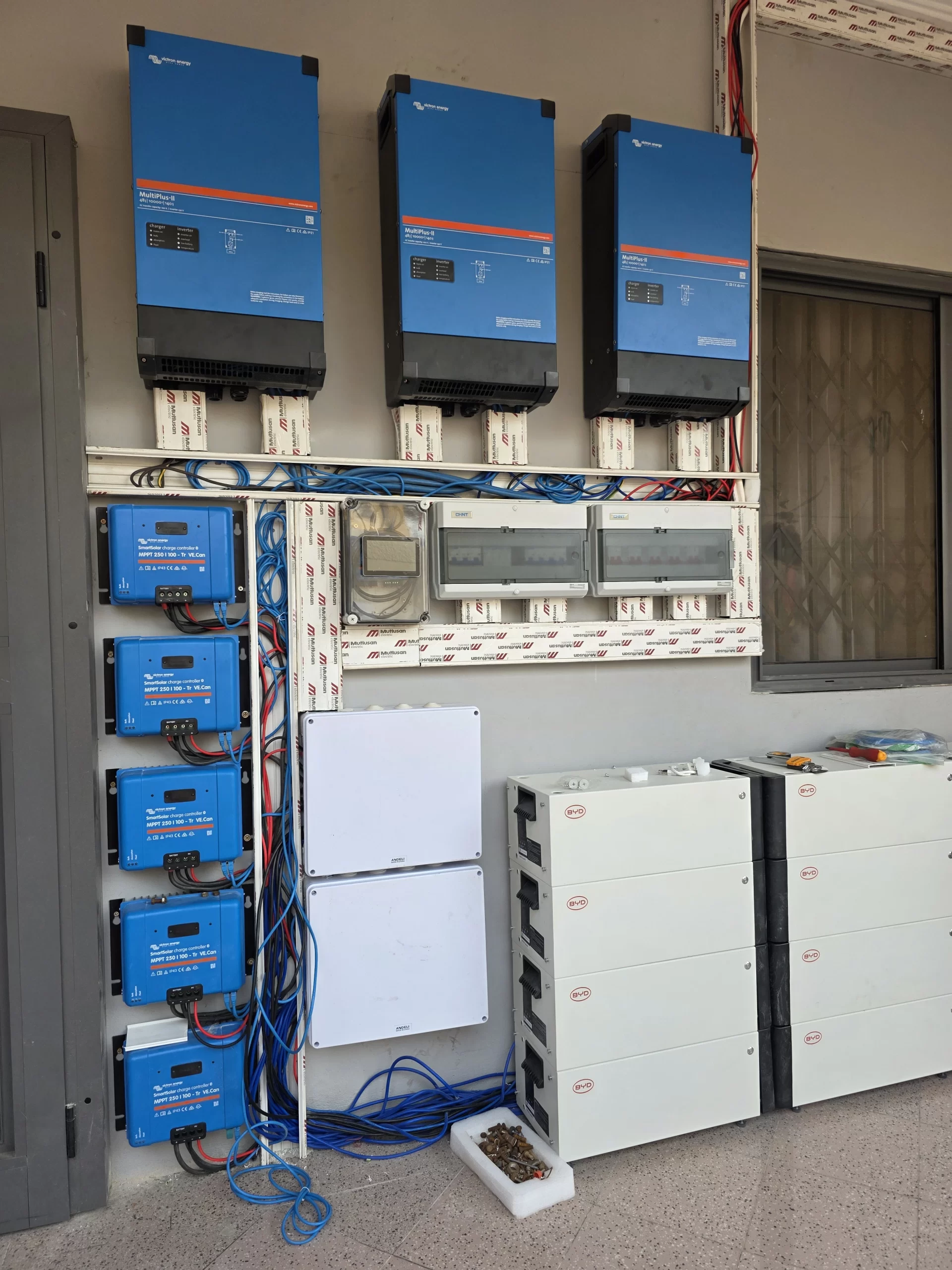
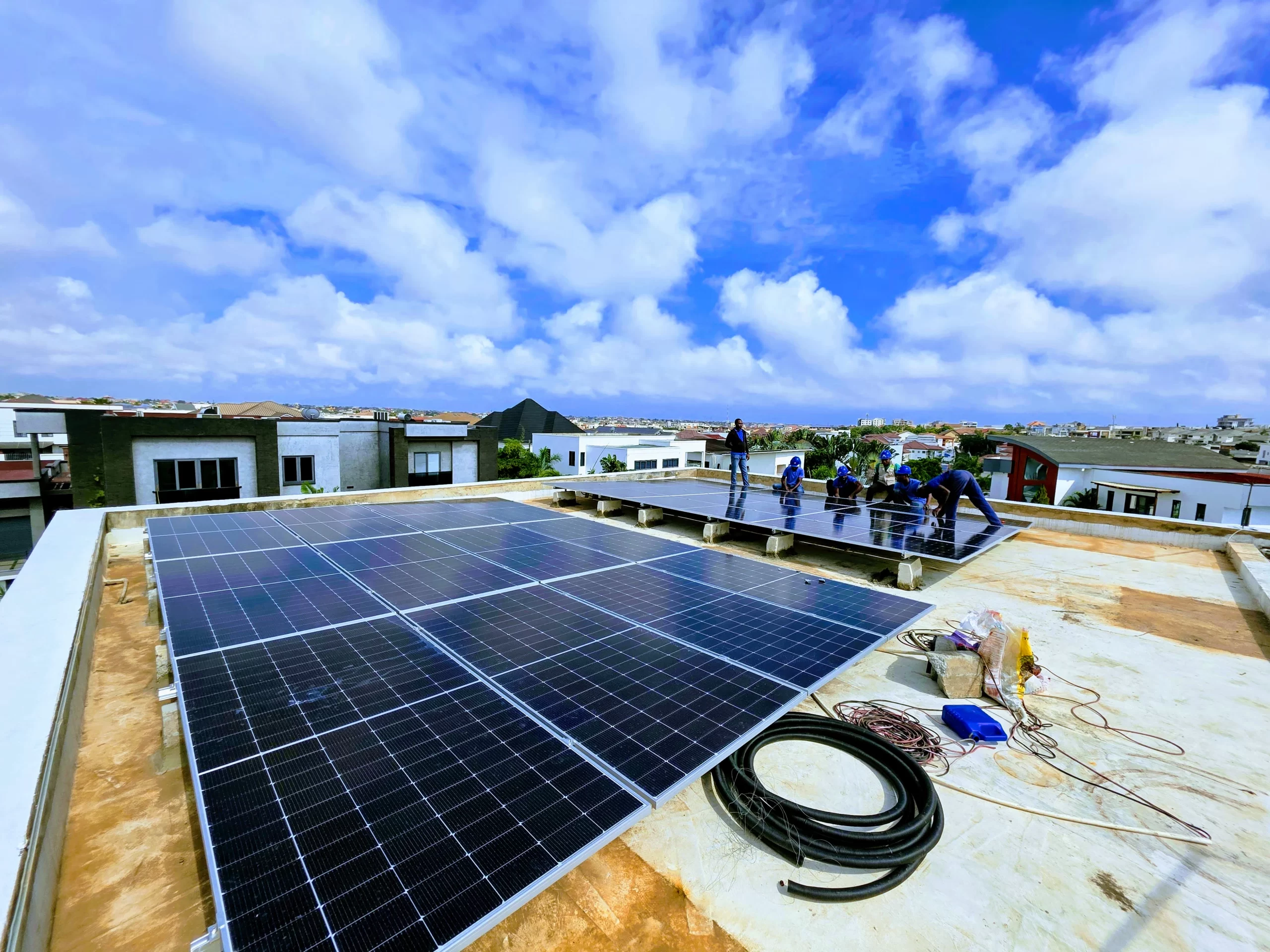
Solar System Components in Ghana: Why the Solar Panel Is Only One Part of the System
When people discuss solar system components in Ghana, the conversation usually begins and ends with three products:
- Solar panels
- Inverter
- Battery
Those components are important. They are not the complete system.
A reliable solar installation also depends on mounting, cables, connectors, fuses, circuit breakers, isolators, surge protection, earthing, distribution equipment, monitoring, configuration, documentation and workmanship.
These supporting elements are often called the balance of system.
They rarely receive the same attention as a large battery or high-wattage panel. Yet they can determine whether the system is safe, efficient, maintainable and reliable.
The quality of a solar system is not defined by its most expensive component. It is limited by its weakest important component or connection.
1. Solar PV modules
Solar panel modules convert sunlight into direct-current electricity.
When comparing modules, consider more than the number of panels.
Important factors include:
- Manufacturer and exact model
- Rated power
- Cell technology
- Module efficiency
- Temperature behaviour
- Mechanical dimensions
- Electrical characteristics
- Product warranty
- Performance warranty
- Compatibility with the inverter or charge controller
- Suitability for the site and mounting arrangement
Nocheski Solar’s guide to solar-panel technology in Ghana explains technologies such as monocrystalline, PERC, TOPCon, HJT and bifacial modules.
The key lesson is that high-wattage panels still require correct electrical design and suitable mounting.
2. Mounting structure
The mounting system connects the solar array to the roof, ground structure or other support.
It must address:
- Roof or site type
- Structural condition
- Wind exposure
- Corrosion environment
- Drainage and water paths
- Module clamping zones
- Thermal movement
- Access for maintenance
- Cable support
- Future roof work
Poor mounting can create movement, corrosion, damaged modules, water ingress or expensive removal and reinstallation.
A solar company should not drill into a roof without understanding the roofing material, structure and appropriate sealing method.
For ground-mounted systems, foundations, alignment, vegetation, security and drainage also matter.
3. PV cables
PV cables carry DC electricity from the modules through strings, combiner equipment or isolators to the inverter or charge controller.
They may be exposed to:
- High temperatures
- Sunlight
- Moisture
- Roof surfaces
- Mechanical stress
- Animals or accidental damage
Cable type, conductor size, voltage rating, route length, support and termination must suit the application.
Loose, damaged or poorly selected cables can reduce performance and create hazards.
4. Solar connectors
Connectors allow PV modules and cables to be joined.
They may look simple, but their quality and assembly are critical.
Risks include:
- Poor crimping
- Incomplete engagement
- Contamination
- Water ingress
- Mismatched connector types
- Mechanical strain
- High-resistance connections
Installers should use compatible, traceable connectors and appropriate tools.
Mixing components because they appear to fit can create unreliable connections.
5. Combiner boxes and string protection
Larger arrays may use combiner boxes to bring several PV strings together.
Depending on the design, these assemblies can include:
- String fuses
- Circuit breakers
- Surge protection
- Isolation
- Monitoring
- Terminals
- Enclosures
The enclosure must suit the location, voltage and environmental exposure.
Components should be clearly labelled and accessible to competent personnel.
A box full of devices is not proof of a good design. Each component should have a defined purpose and rating.
6. DC isolation
DC isolators allow parts of the PV system to be disconnected for operation, maintenance or emergency procedures, subject to the system architecture.
DC switching can be demanding because direct current does not behave exactly like alternating current.
Devices must be suitable for DC voltage, current, polarity and switching arrangement.
Using an inappropriate AC device on a DC circuit can be dangerous.
Selection and installation should follow equipment instructions and applicable electrical requirements.

7. Solar charge controller or MPPT
In systems where the inverter does not contain the required solar charging stage, a charge controller manages energy from the PV array to the battery.
Modern maximum power point tracking controllers can improve energy harvesting by continuously operating the array near an efficient point under changing conditions.
Key considerations include:
- Maximum PV voltage
- Maximum input current
- Charging current
- Battery voltage
- Battery chemistry and settings
- Communication and monitoring
- Temperature and installation environment
- Expansion capability
An incorrectly designed array can exceed controller limits or waste available solar capacity.
8. Inverter or inverter-charger
The inverter converts DC electricity into AC electricity for appliances and equipment.
An inverter-charger may also charge batteries from the grid or generator and manage several energy sources.
Selection should consider:
- Continuous power
- Surge capability
- Single-phase or three-phase needs
- Battery voltage
- Grid and generator compatibility
- Solar-input architecture
- AC input and output limits
- Parallel operation
- Monitoring
- Control strategy
- Warranty and local support
The inverter is the control centre of many systems, but it cannot compensate for an inadequate battery, poor cable design or incorrect protection.
9. Battery energy storage
The battery stores electricity for use when generation or grid supply is insufficient.
Important battery characteristics include:
- Chemistry
- Nominal capacity
- Usable capacity
- Continuous and peak power
- Battery-management system
- Voltage range
- Inverter compatibility
- Temperature limits
- Cycle and throughput conditions
- Scalability
- Warranty
Battery capacity should be based on the customer’s energy requirement, not the physical size of the enclosure or whichever model the seller wants to move.
Read Nocheski Solar’s guide to solar battery storage in Ghana for a broader introduction.
10. Battery cables, busbars and fuses
Battery circuits can carry very high current.
They require:
- Correctly sized conductors
- Short, well-planned routes where practical
- Quality lugs and terminations
- Appropriate fusing or circuit protection
- Suitable busbars and distribution
- Mechanical protection
- Correct polarity
- Clear identification
Victron Energy’s Wiring Unlimited guidance explains how insufficient cable thickness and poor connections increase voltage drop and heating in DC systems.
Do not judge battery cables by appearance alone. Correct sizing depends on current, length, voltage drop and installation conditions.
11. AC distribution and protection
The inverter’s AC output must be integrated into the building’s electrical system.
This may involve:
- Input and output breakers
- Residual-current protection where applicable
- Surge protection
- Changeover or transfer arrangements
- Critical-load distribution
- Generator integration
- Grid connection
- Distribution-board modifications
- Earthing and bonding
The existing electrical installation should be inspected before integration.
Solar does not repair bad wiring automatically.
12. Surge protection and lightning considerations
Solar panel arrays and long cable routes may be exposed to electrical surges.
The protection strategy should consider the site, electrical installation, equipment and local exposure.
Surge protection devices are not decorative accessories. They must be correctly selected, coordinated, installed and earthed.
A complete lightning-protection assessment may be required for certain buildings and sites. Installing one device does not guarantee protection against every possible event.
Be cautious of absolute promises such as “this breaker prevents all lightning damage.”
13. Earthing and bonding
Earthing supports safety and the operation of protective measures.
The design may need to address:
- Equipment enclosures
- Mounting structures
- Distribution equipment
- Existing building earth
- Surge protection
- Generator and grid arrangements
- Manufacturer instructions
Earthing is not simply pushing a rod into the soil and attaching any available wire.
It requires a coherent system design, suitable materials and testing by competent personnel.
14. Monitoring and communications
Monitoring helps customers and technicians understand what the system is doing.
Depending on the equipment, it can show:
- Solar generation
- Battery state of charge
- Consumption
- Grid or generator use
- Alarms
- Historical performance
- Equipment status
Remote monitoring can support faster diagnosis, but it depends on correct configuration, communication devices and internet availability.
The customer should receive access credentials and understand who owns the data and account.
15. Labels, diagrams and documentation
Good documentation is part of the installation.
Labels help identify circuits, isolation points and hazards.
Diagrams and records help future technicians understand the system without starting from zero.
Useful documents may include:
- Equipment schedule
- Serial numbers
- Single-line diagram
- Cable information
- Protection details
- Configuration records
- Commissioning report
- Warranty documents
- Monitoring instructions
- Maintenance recommendations
An undocumented system is harder to maintain and more expensive to troubleshoot.
16. Design, workmanship and commissioning
These are not physical products, but they are essential system components.
Even excellent equipment can perform poorly when:
- The load assessment is wrong
- The array is badly configured
- The battery is undersized
- Connections are weak
- Settings are incorrect
- Protection is inappropriate
- Testing is incomplete
- The customer is not trained
This is why buying solar as a list of products is dangerous.
The value lies in how the components are selected, integrated and supported.
Why the same panels can produce two very different systems
Imagine two companies both offer twelve panels of the same model.
Company A includes:
- Engineered array configuration
- Suitable mounting
- Quality connectors
- Correct cable sizing
- Appropriate protection
- Reliable inverter and battery integration
- Monitoring
- Testing
- Documentation
- After-sales support
Company B includes:
- Panels
- An inverter
- A battery
- “Assorted accessories”
These are not equivalent proposals.
The panel brand is only one line in the system design.
Ghana’s cable and accessory requirements matter
The Ghana Energy Commission’s Electrical Wiring Cables and Electrical Wiring Accessories Regulations, 2023 (L.I. 2478) establish minimum standards and testing requirements for wiring cables and accessories.
The Commission has warned that substandard products can expose the public to fire and electrocution hazards.
Customers should therefore ask where electrical materials come from and whether they are suitable and approved for the intended application.
Frequently asked questions
What are the main components of a home solar system in Ghana?
A typical system may include solar modules, mounting, PV cabling, protection, inverter or inverter-charger, battery storage, AC integration, earthing, monitoring and documentation. The exact architecture depends on the project.
Is the inverter more important than the battery?
They perform different functions and must be compatible. A premium inverter cannot make an undersized or unsuitable battery deliver the required energy.
Can I buy components separately and ask an installer to connect them?
It is possible, but compatibility, warranty and system design must be verified before purchase. Buying first and engineering later can create expensive problems.
Why are balance-of-system components important?
They connect, protect, support and control the major equipment. Weak balance-of-system design can reduce performance, reliability and safety even when the panels and battery are high quality.
Final advice
Do not ask only:
“Which Solar panels and battery am I getting?”
Also ask:
“How will everything be mounted, connected, protected, controlled, tested, documented and supported?”
That is the difference between buying products and buying an engineered solar system.
Build a complete energy solution with Nocheski Solar
Nocheski Solar supplies solar panels, inverters, battery storage, electrical equipment, test instruments and related energy solutions throughout Ghana and across West Africa.
Explore our solar and electrical product catalogue, read about why poorly designed solar systems fail, or contact our technical team for professional system design and installation.
The panel may capture the sunlight. The complete system determines what happens next.


 GRADE refers to the quality of solar cell used in the solar panel, and are categorized as A, B, C, or D. “Grade A” cells are the highest quality, in that they are tested to ensure there are no micro-cracks in the solar cell, and all the cells are of the same type. The quality diminishes for grade B, which may have micro cracks and not all cells are of the same type (they sometimes mix and match). Grades C and D are much worse quality with larger cracks and chips, and the cell mismatch is even worse since typical solar cell will be exposed to sunlight throughout its lifetime. Sunlight contains harmful ultraviolet (UV) light that deteriorates all materials, including solar cells. The tiny flaws in the material become worse after prolonged exposure to sunlight, and its power output reduces over time.As a grade A cell has the least flaws to start with, its deterioration will be the slowest.