
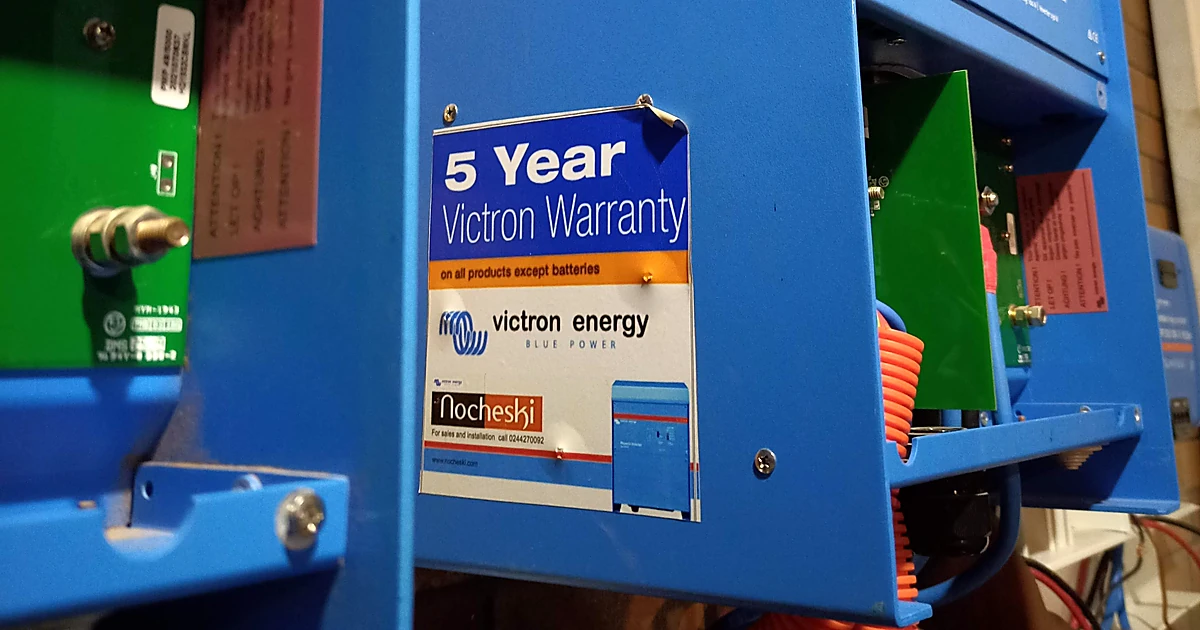
Solar Warranty in Ghana: What Every Buyer Must Check Before Installation
A solar warranty in Ghana can look reassuring on a quotation.
Five years.
Ten years.
Twenty-five years.
But the number alone tells you almost nothing.
Customers often assume that one long warranty covers the entire solar system, all labour, every service visit and any loss of performance. In reality, a solar installation may contain several different warranties issued by different organisations under different conditions.
The most important warranty question is therefore not:
“How many years?”
It is:
“What exactly is covered, by whom, under what conditions and at whose cost?”
The five warranties customers commonly confuse
A complete solar power system can contain several forms of cover.
1. Solar-panel product warranty
This generally relates to defects in materials or manufacturing during a stated period.
It may address issues such as premature component failure, depending on the manufacturer’s terms.
It does not automatically mean the panel is guaranteed to produce its original output for the full period.
2. Solar-panel performance warranty
This normally describes the manufacturer’s commitment that panel output will not fall below a specified percentage over time, subject to the warranty conditions.
A performance warranty is different from a product warranty.
A panel may still operate while producing less energy than expected because of shading, dirt, wiring, inverter settings, design error or site conditions. Those issues may not be panel-manufacturer defects.
3. Inverter warranty
The inverter manufacturer may cover defined equipment faults for a specified period.
Coverage can depend on:
- Correct installation
- Approved operating conditions
- Proper commissioning
- Serial-number records
- Product registration
- Firmware or configuration requirements
- Excluded causes such as misuse or external damage
The customer should know whether the local installer, distributor or manufacturer handles the claim.
4. Battery warranty
Battery warranties can be more complex than customers expect.
Terms may consider:
- Years in service
- Energy throughput
- Cycle count
- Remaining capacity
- Temperature limits
- Depth of discharge
- Compatible inverter operation
- Communication with the battery management system
- Installation and registration requirements
A battery warranty is not simply a promise that the battery will perform like new until the final day.
5. Installer workmanship warranty
This covers defined installation defects for which the installer is responsible.
It may relate to workmanship involving:
- Cable termination
- Mounting
- Equipment installation
- Configuration
- Labelling
- Integration
The exact scope should be written clearly.
A workmanship warranty does not replace the equipment manufacturer’s warranty, and an equipment warranty does not excuse poor workmanship.
A long warranty from a disappearing installer has little value
This is the uncomfortable truth.
A 10-year workmanship warranty from a company that closes after three years has effectively become a three-year warranty.
Solar businesses sometimes fail because they price installations too low to support future obligations. The company completes many projects on thin margins, promises long warranties and later becomes overwhelmed by service calls, transport costs, labour and replacement work.
Customers then call a new installer to diagnose a system they did not design.
That new company must spend time identifying equipment, tracing wiring, checking configuration and separating installation faults from product faults.
The customer may pay again simply to discover what is wrong.
This is why the financial and operational stability of the installer matters.
You are not only buying equipment. You are buying the probability that competent help will still exist when you need it.
What a solar warranty may not cover
Warranty exclusions vary, but customers should ask about issues such as:
- Physical damage
- Lightning or external electrical surges
- Flooding, fire or extreme environmental exposure
- Unauthorised modification
- Installation by an unapproved person
- Operation outside specified limits
- Poor maintenance
- Internet or communication failure
- Damage from the existing electrical installation
- Generator or grid-quality problems
- Consumable items
- Transport and travel
- Labour for removal and replacement
- Loss of income or business interruption
Do not assume. Read the actual terms.
If the quotation says “10-year warranty” but no warranty document is available, the claim is incomplete.
Ask who pays for diagnosis
When a solar system stops performing, the cause is not always obvious.
Possible causes include:
- Equipment failure
- Loose or damaged connections
- Incorrect settings
- Changed customer loads
- Shading or dirt
- Communication problems
- Grid or generator conditions
- Battery operating limits
- Tripped protection
- External damage
Diagnosis requires time, tools and expertise.
Ask:
- Is remote diagnosis included?
- Is a site visit free during the warranty period?
- Who pays transport to a remote location?
- Is labour included if the manufacturer accepts the claim?
- Who pays if no product defect is found?
- Is there a defined response process?
Clear answers prevent conflict later.
Product replacement does not always mean free system restoration
A manufacturer may approve replacement of a defective component.
But several other tasks may still be required:
- Diagnose the fault.
- Remove the equipment.
- Package and transport it.
- Submit documentation.
- Wait for assessment or replacement.
- Install the replacement.
- Reconfigure the system.
- Test and recommission it.
Find out which party is responsible for each stage.
A customer may receive a replacement product but still face labour and logistics costs if those items are excluded.
Documentation protects your warranty
A professional handover should leave the customer with useful records.
Depending on the system, these may include:
- Final quotation and contract
- Equipment make, model and serial numbers
- Manufacturer warranty documents
- Installer workmanship warranty
- Invoices and proof of purchase
- System diagram or equipment schedule
- Configuration records
- Commissioning report
- Monitoring access
- Product-registration confirmation
- Maintenance instructions
- Contact and escalation procedure
Do not leave warranty evidence only inside the installer’s phone or email account.
The customer should possess copies.
Register equipment when required
Some manufacturers or distributors require product registration within a defined period or request specific information when a claim is made.
Ask the installer:
- Does any equipment require registration?
- Who completes it?
- Whose email address is used?
- Will the customer receive confirmation?
- Does an extended warranty require additional action or payment?
The system owner should not discover an uncompleted registration only after equipment fails.
Maintenance and warranty are connected
A warranty does not eliminate the need for maintenance.
Solar systems should be inspected according to the equipment, site and operating conditions. Maintenance may involve:
- Visual inspection
- Cleaning where necessary
- Checking for physical damage
- Reviewing alarms and monitoring data
- Checking ventilation and environmental conditions
- Verifying connections and protection through competent personnel
- Updating records after changes
Questions to ask about a solar warranty in Ghana
Before signing, ask:
- What warranty applies to each panel, inverter, battery and major accessory?
- Is the period a product warranty, performance warranty or workmanship warranty?
- Who issued each warranty?
- Who receives and manages a claim in Ghana?
- Is the equipment sourced through an authorised channel?
- Is product registration required?
- Are diagnosis, labour and transport included?
- What exclusions apply?
- What maintenance is required?
- What happens if the original installer is unavailable?
- Will Nocheski or another local technical partner retain system records?
- What documents will the customer receive at handover?
Do not accept “everything is covered” as an answer.
Red flags in warranty promises
Be cautious when:
- The warranty period is stated but no terms are available.
- The installer cannot identify the local warranty channel.
- The equipment has no traceable model or serial information.
- The warranty supposedly covers everything without exclusions.
- The installer says the manufacturer’s warranty automatically covers labour.
- The company has no visible technical support structure.
- The quotation promises a very long workmanship warranty from a new or informal operation without explaining how support will be funded.
- The customer is discouraged from keeping documentation or monitoring access.
Professional companies should make warranty responsibilities clearer, not more mysterious.
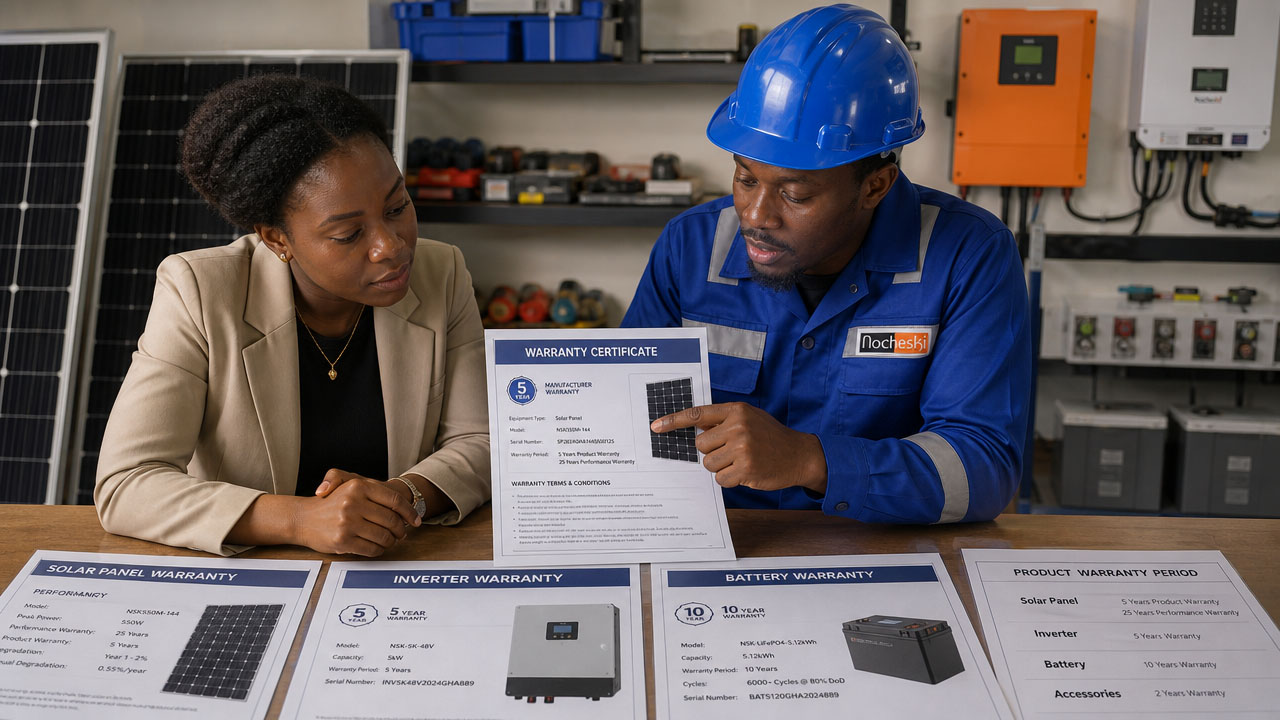
How Nocheski Solar customers should evaluate warranty value
Warranty value comes from the combination of:
- Reputable equipment
- Correct design
- Professional installation
- Traceable supply channels
- Accurate documentation
- Proper commissioning
- Responsible operation
- Accessible technical support
The strongest warranty is the one you are least likely to need because the system was designed and installed correctly—and the one that can still be honoured if a genuine defect occurs.
Frequently asked questions
Is a 25-year solar-panel warranty the same as a 25-year complete-system warranty?
No. A long panel performance warranty does not automatically cover the inverter, battery, labour, wiring or installation workmanship.
Does a battery warranty guarantee full capacity for the entire period?
Usually not. Battery warranties have specific performance thresholds, operating limits and conditions. Read the manufacturer’s terms for the exact product.
Who should handle a solar warranty claim in Ghana?
That depends on the supply chain and contract. The customer should establish before purchase whether the installer, local distributor or manufacturer will manage the claim.
Does warranty cover lightning damage?
Do not assume it does. External electrical events and surge damage are commonly subject to exclusions or separate conditions. Appropriate system protection and insurance should be discussed.
Final advice
Do not be seduced by the largest warranty number on a quotation.
Ask for clarity.
Choose a solar company built for long-term support
Nocheski Solar supplies and supports solar, inverter, battery-storage and electrical solutions across Ghana and West Africa.
Read our guide to choosing a solar installation company in Ghana, explore our product catalogue, or contact the technical team to discuss equipment, installation and support requirements.
A warranty is only as useful as its terms, documentation and the organisation standing behind it.