Victron SmartSolar MPPT Charge Controllers in Ghana: Models, Sizing & Engineering Guide

Updated September 2026

Choosing the right solar charge controller is one of the most important design decisions in a battery-based solar power system. An incorrectly sized controller can restrict solar production, compromise charging performance, cause nuisance shutdowns or, in the worst case, expose equipment to voltages and currents outside its operating limits.

For homes, businesses, telecom installations, remote facilities and professionally engineered off-grid or hybrid solar systems, Victron Energy SmartSolar MPPT charge controllers provide a highly flexible platform for converting energy from a solar PV array into controlled battery charging.

At Nocheski Solar, we supply, design, install, commission and support Victron-based solar and battery systems in Ghana. Our approach goes beyond simply selecting a controller by wattage. Correct MPPT selection requires consideration of solar-panel electrical characteristics, array configuration, battery voltage, battery chemistry, charging requirements, environmental conditions and the architecture of the complete energy system.

This guide explains how Victron SmartSolar MPPT controllers work, what the model numbers mean, how to select the appropriate controller and what buyers in Ghana should consider before purchasing one.

What Is a Victron SmartSolar MPPT Charge Controller?

A solar charge controller sits between the photovoltaic array and the battery bank. Its job is to extract usable power from the solar panels and regulate the voltage and current delivered to the batteries.

MPPT means Maximum Power Point Tracking.

Solar panels do not produce their maximum available power at one fixed voltage throughout the day. Irradiance, temperature, shading and other operating conditions continually change the panel’s optimum operating point.

A Victron SmartSolar MPPT continuously tracks this point and converts the available PV power into the voltage and current required to charge the battery efficiently.

Victron states that its ultra-fast MPPT technology can harvest up to 30% more energy than PWM charge controllers under relevant operating conditions, with the advantage particularly noticeable when solar irradiance changes.

This should not be confused with saying that an MPPT is simply “30% more efficient.” The actual advantage depends on the PV array, battery voltage, weather, operating conditions and system design.

Why MPPT Is Usually Preferable to PWM

A traditional PWM controller effectively forces the PV array to operate much closer to battery voltage. That can leave part of the available solar-panel power unused.

An MPPT controller operates the array closer to its optimum power point and then performs the required DC-to-DC conversion for battery charging.

This also gives system designers considerably more flexibility when configuring PV strings because the array voltage can be substantially higher than the battery voltage, provided all voltage, current and equipment limits are respected.

For modern lithium-based solar systems and larger PV arrays, professional system design will therefore usually favour MPPT technology rather than PWM.

Understanding Victron SmartSolar Model Numbers

Victron’s model numbers contain useful engineering information.

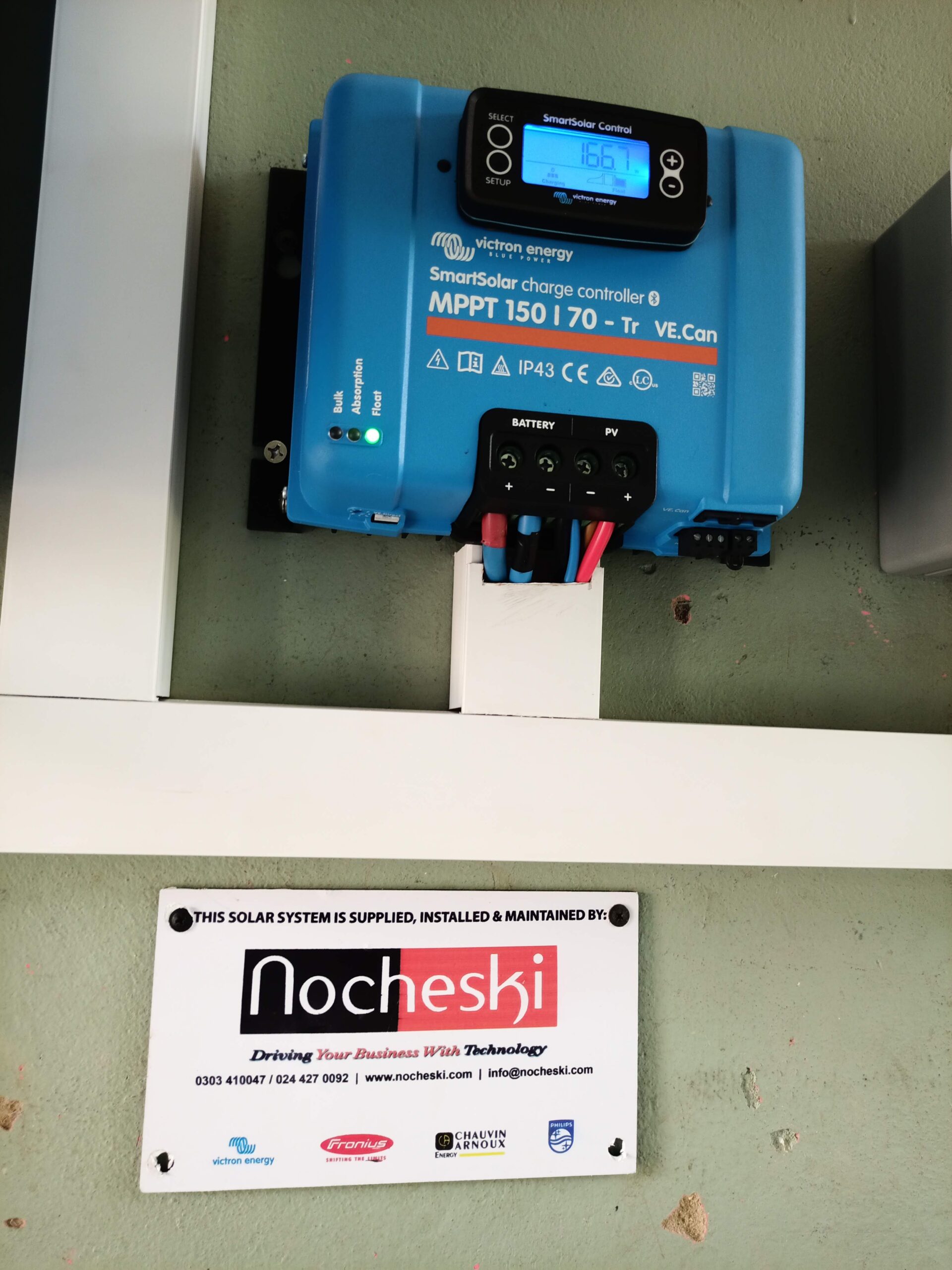
Consider the SmartSolar MPPT 150/70.

The first number, 150, indicates the controller’s maximum PV open-circuit voltage class.

The second number, 70, represents the maximum battery charge current in amperes.

Similarly, a SmartSolar MPPT 250/100 belongs to the 250 V PV-input class and can deliver up to 100 A of battery charge current.

This does not mean that a designer should simply connect a PV array with a calculated open-circuit voltage of exactly 150 V to a 150 V controller or exactly 250 V to a 250 V controller.

PV open-circuit voltage changes with temperature. Correct design therefore requires the calculated maximum string Voc, including temperature effects and appropriate engineering margin, to remain within the limits specified by Victron.

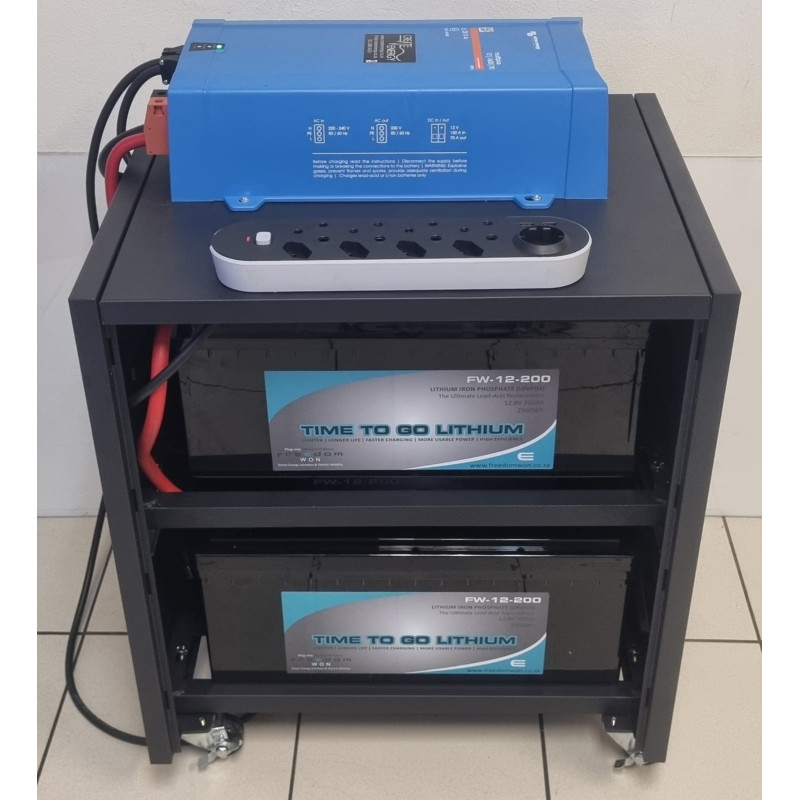
victron energy SmartSolar MPPT 150-70-Tr VE Can -LEFT
victron energy SmartSolar MPPT 150-70-Tr VE Can avaialble in Ghana

Popular Victron SmartSolar MPPT Models

The SmartSolar family covers systems ranging from small battery installations to much larger multi-controller PV systems.

SmartSolar model Maximum PV voltage class Maximum charge current Typical supported battery voltages* Example nominal PV capacity
MPPT 75/10 75 V 10 A 12/24 V 290 W at 24 V
MPPT 75/15 75 V 15 A 12/24 V 440 W at 24 V
MPPT 100/20 100 V 20 A 12/24/48 V 580 W at 24 V
MPPT 100/30 100 V 30 A 12/24 V 880 W at 24 V
MPPT 100/50 100 V 50 A 12/24 V 1,400 W at 24 V
MPPT 150/70 VE.Can 150 V 70 A 12/24/36/48 V 4,000 W at 48 V
MPPT 250/70 VE.Can 250 V 70 A 12/24/36/48 V 4,000 W at 48 V
MPPT 250/100 VE.Can 250 V 100 A 12/24/36/48 V 5,800 W at 48 V

*Exact compatibility must always be checked against the current Victron datasheet, product part number and physical product label before system design or installation. Some variants within product families can have different voltage limitations.

For example, Victron specifies the SmartSolar 250/100 VE.Can at up to 100 A battery charge current, with nominal PV power of 5,800 W on a 48 V battery system and peak conversion efficiency of 99%.

The table should therefore be treated as a selection guide rather than a substitute for engineering calculations.

How to Choose the Correct Victron SmartSolar MPPT

Correct MPPT sizing starts with the solar array and battery system, not with whichever controller happens to be available on the shelf.

At minimum, the designer should establish the solar-panel wattage, open-circuit voltage (Voc), voltage at maximum power (Vmp), short-circuit current (Isc), current at maximum power (Imp), number of panels, proposed series/parallel configuration, battery-system voltage, battery chemistry and charging-current limitations.

For example, simply knowing that a customer has “six 600 W panels” is not enough.

Six panels represent 3.6 kWp, but their correct configuration depends on each panel’s Voc, Vmp, Isc and temperature coefficient. Putting all six in series may exceed one controller’s permissible PV voltage while a different series-parallel arrangement may be acceptable.

The correct controller is therefore determined by electrical characteristics, not panel wattage alone.

PV Voltage Is Critical

Exceeding an MPPT’s maximum allowable PV open-circuit voltage can damage the equipment.

This is one of the most important reasons to avoid casual solar-system sizing based only on internet calculators or rules of thumb.

For Victron’s 150 V and 250 V VE.Can controller families, the model designation tells you the voltage class, but Victron’s manuals provide additional operating and start-up limits that must also be respected.

A professional design checks the array’s maximum possible open-circuit voltage rather than merely its normal operating voltage.

Charge Current and Battery Requirements Matter Too

The second part of MPPT selection is determining whether the controller’s charging capability is appropriate for the battery bank.

A 100 A MPPT is not automatically “better” than a 70 A MPPT.

The correct charging current depends on the PV capacity, battery-bank voltage, battery chemistry, battery capacity, battery-management system and the manufacturer’s permitted charge rate.

Oversizing components without understanding the system architecture wastes money. Undersizing them can constrain solar harvesting and battery charging.

Engineering is inconvenient like that. Numbers remain stubbornly more important than product labels.

Victron SmartSolar and Lithium Batteries

Victron SmartSolar MPPT controllers can be configured for different battery charging requirements, including lithium and lead-acid battery systems.

However, “lithium compatible” should not be interpreted as permission to connect any lithium battery to any controller with arbitrary settings.

A correctly engineered lithium installation must consider the battery manufacturer’s required charge voltages, current limits, battery management system, communications architecture and required charge-control behaviour.

This becomes particularly important in integrated Victron systems where the MPPT, inverter/charger, GX device and compatible battery BMS may exchange information to coordinate system operation.

At Nocheski Solar, we therefore treat the battery, inverter/charger, MPPT and monitoring platform as parts of one system, rather than unrelated products assembled simply because their voltage labels appear to match.

Built-In Bluetooth and VictronConnect

One of the practical advantages of the SmartSolar range is built-in Bluetooth on applicable SmartSolar models.

Using the VictronConnect application, installers and users can access operating data and configure supported parameters locally.

Depending on the model and system, VictronConnect can provide information such as PV voltage, PV power, battery voltage, charge current, charging stage, daily yield and historical performance.

This is extremely useful for commissioning, troubleshooting and routine system observation.

Bluetooth, however, should not be confused with internet-based remote monitoring.

Bluetooth Monitoring vs VRM Remote Monitoring

When a phone connects directly to a SmartSolar MPPT using Bluetooth, the user is communicating locally with the controller.

For genuine remote access over the internet, compatible Victron devices can be integrated with a GX communication device, such as a Cerbo GX, and connected to the Victron Remote Management (VRM) portal.

Victron also provides VictronConnect-Remote functionality for compatible products connected appropriately through a GX system.

This allows a professionally integrated Victron installation to be monitored from another town, another region or another country rather than requiring someone to stand beside the controller with a telephone.

For commercial, institutional and critical installations, this monitoring architecture can be extremely valuable for performance analysis, alarm management, diagnostics and technical support.

SmartSolar vs BlueSolar: What Is the Difference?

Victron offers both SmartSolar and BlueSolar charge controllers.

One of the most visible practical differences across comparable product ranges is connectivity. SmartSolar products are associated with integrated Bluetooth functionality, while BlueSolar products may require an additional communications accessory for Bluetooth access.

The precise differences depend on the individual model.

For a new system where easy commissioning and local smartphone monitoring are important, SmartSolar is often the more convenient choice.

The decision should nevertheless be based on the required electrical specifications, communications architecture and total system design rather than the product name alone.

Why Victron SmartSolar Is Well Suited to Professional Solar Systems in Ghana

Ghana offers excellent solar potential, but good irradiation does not eliminate the need for disciplined system engineering.

Equipment can operate in high ambient temperatures, electrical enclosures may experience significant heat build-up, and installations may be exposed to dust, humidity, lightning-related transients and poor installation practices.

Victron specifies operating-temperature and environmental limits for its controllers. For example, larger SmartSolar units covered by Victron’s 150/70-to-250/100 VE.Can manual are specified for operation from -30°C to +60°C, with full rated output up to 40°C.

That does not mean the equipment should simply be placed in an unventilated hot enclosure because “it can handle Africa.”

Professional installation should consider ventilation, cable sizing, DC protection, isolation, surge protection, earthing, equipment clearances and the environmental protection of the installation area.

The MPPT itself also does not correct unstable ECG grid voltage. Grid quality is an AC-side system issue that must be addressed through the appropriate inverter/charger, protection and power-conditioning architecture.

SmartSolar MPPTs for Residential Solar Systems

For residential battery systems, SmartSolar MPPT controllers can form part of a highly flexible DC-coupled architecture.

Smaller models may be suitable for modest DC systems, while larger 150 V and 250 V controllers can support significantly greater PV capacities on higher-voltage battery banks.

The best choice depends on the actual energy requirement and system architecture.

A professional residential design should therefore start with the customer’s load profile, required autonomy, battery capacity and desired PV recharge time before selecting an MPPT.

SmartSolar for Commercial, Institutional and Remote Systems

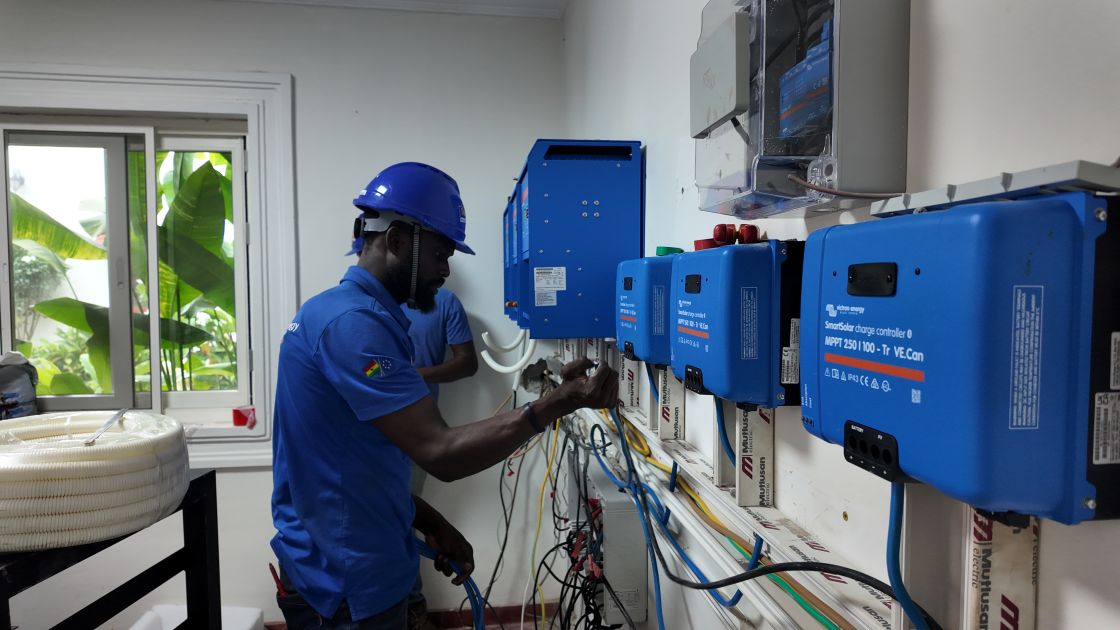
Larger SmartSolar MPPTs can also be deployed as multiple coordinated controllers.

This is useful where a large PV array is divided between several controllers, different roof orientations need to be accommodated or redundancy and system modularity are desirable.

Selected VE.Can models support synchronised parallel operation and communications with the wider Victron ecosystem.

This makes SmartSolar particularly useful in professionally engineered DC-coupled battery systems for businesses, communications facilities, health facilities, remote sites, educational institutions and other applications where reliability and visibility of system performance are important.


The Nocheski Engineering Approach

Nocheski Solar does not size an MPPT by looking only at the total wattage written on the solar panels.

Our design process considers the complete electrical system.

Where appropriate, this includes empirical load assessment, PV-array electrical calculations, battery capacity and BMS requirements, inverter/charger architecture, DC cable calculations, protection coordination, surge protection, monitoring, commissioning and post-installation performance analysis.

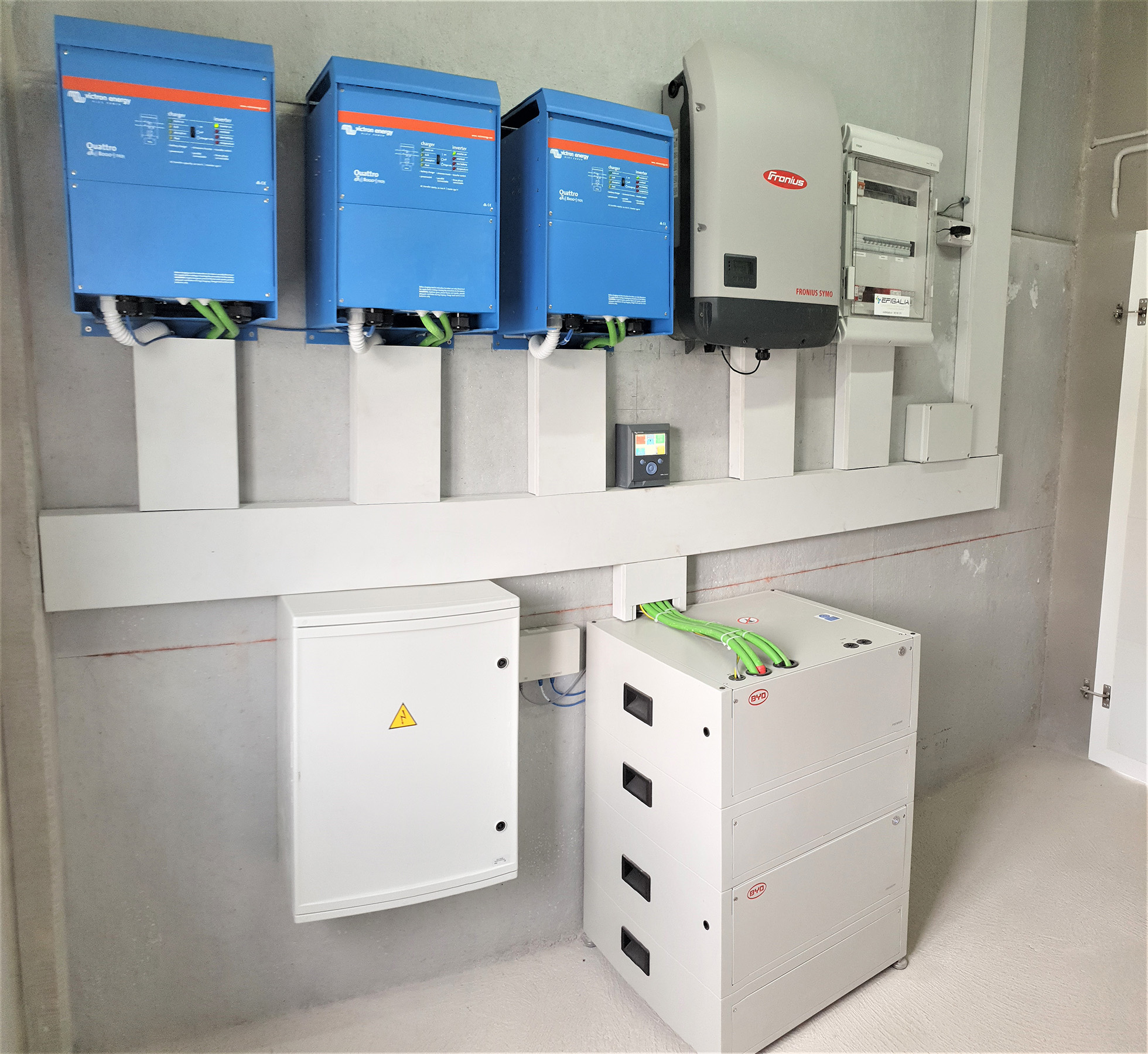
For larger Victron systems, several SmartSolar controllers may be incorporated into one energy architecture and monitored through a GX device and VRM.

This approach matters because premium components cannot compensate for poor engineering.

A correctly designed system using appropriately selected equipment will almost always outperform an expensive collection of components that were never properly engineered to work together.

Why Buy Victron SmartSolar MPPT Controllers from Nocheski Solar?

Nocheski Solar has operated since 2007 and specialises in solar-energy systems, battery storage, power engineering and related technical solutions.

We supply Victron Energy equipment, but our principal value is not simply moving boxes across a counter.

Customers can obtain engineering support for controller selection, PV-string configuration, lithium battery integration, system protection, commissioning, monitoring and troubleshooting.

Nocheski also designs and installs complete Victron-based systems for residential, commercial, industrial and institutional applications in Ghana and has undertaken renewable-energy work beyond Ghana within the West African sub-region.

For a customer buying professional-grade equipment, access to competent local technical support can be as important as the hardware itself.

Victron SmartSolar MPPT Price in Ghana

The price of a Victron SmartSolar MPPT in Ghana depends principally on the model, current stock, exchange rate, import costs and whether the requirement involves supply only or engineering and installation services.

A small SmartSolar controller and a 250/100 VE.Can are very different pieces of equipment and should not be compared merely on price.

Where current prices are displayed on Nocheski’s product pages, customers should check the applicable product listing. For larger models, multiple-unit requirements and project installations, Nocheski can provide a project-specific quotation.

Most importantly, customers who are uncertain about the correct controller should obtain the sizing calculation before purchasing the hardware.

Buying the wrong MPPT cheaply does not make it a bargain.

What Information Does Nocheski Need to Size Your Victron MPPT?

For accurate preliminary selection, provide Nocheski Solar with the number of solar panels, panel wattage, panel Voc, panel Vmp, panel Isc, battery-system voltage, battery type or model and any existing inverter or Victron equipment.

A photograph of the panel nameplate is often more useful than typing specifications from memory.

For existing or larger systems, a single-line diagram, photographs of the installation and information about current equipment can significantly improve the assessment.

Where necessary, Nocheski can undertake a more detailed engineering review or site assessment.

Frequently Asked Questions

Is Victron SmartSolar better than a PWM solar charge controller?

For many modern solar installations, MPPT provides significant technical advantages. Victron states that its ultra-fast MPPT technology can harvest up to 30% more energy than PWM controllers under relevant operating conditions. The exact benefit depends on system configuration and environmental conditions.

Can I monitor a Victron SmartSolar MPPT from my phone?

Yes. Compatible SmartSolar MPPTs include Bluetooth connectivity for local access using the VictronConnect application.

Can I monitor SmartSolar when I am away from the installation?

Yes, but Bluetooth alone does not provide worldwide remote access. Internet-based remote monitoring normally requires appropriate integration with a compatible GX device or other supported communications equipment and Victron’s VRM platform.

Can SmartSolar MPPTs charge lithium batteries?

Yes, appropriately configured SmartSolar controllers can be used in lithium battery systems. Correct charging parameters, BMS requirements, charge-current limitations and system communications must nevertheless be considered.

What does 250/100 mean on a Victron MPPT?

The 250 identifies the controller’s PV voltage class and the 100 represents its maximum battery charge current of 100 A. Array design must still comply with all limits in the applicable Victron documentation.

Can I connect more solar-panel wattage than the nominal rating?

Some PV oversizing can be permissible because the controller can limit input power, but voltage and current restrictions still apply. Oversizing must therefore be calculated rather than assumed.

Is a bigger MPPT always better?

No. The best controller is the one correctly matched to the PV array, battery and overall energy system. Installing an unnecessarily large controller increases cost without automatically improving performance.

Can one solar system use several Victron MPPT controllers?

Yes. Multiple controllers are commonly used in larger Victron systems. Selected models can also be synchronised and integrated through Victron communications platforms. System architecture should be designed accordingly.

Is Victron SmartSolar suitable for Ghana?

Yes, when correctly selected and installed. Appropriate ventilation, electrical protection, PV-string sizing, battery configuration, cable sizing and environmental protection remain essential.

Get the Correct Victron SmartSolar MPPT for Your System

If you are planning a new solar installation, expanding an existing PV array or replacing an incorrectly sized charge controller, selecting the correct MPPT should come before purchasing equipment.

Nocheski Solar can assist with Victron SmartSolar selection, PV string design, battery integration, supply, installation, commissioning and remote-monitoring configuration.

Send us your panel specifications, battery details and existing system information for an engineering assessment.

Nocheski Solar Limited
Tema & Accra, Ghana
Solar Energy Anytime, Anywhere.


seeking the best Solar Installation Company in Ghana?  Choosing the right solar installation company in Ghana may be what turns the difference between a return-on-investment system and one that withers away after a few months. As solar energy adoption gains momentum in Ghana, so has the number of companies that promise quick installation and cheap deals. But when it comes to power sustainably powering your home, business, or institution, expertise and quality matter.

We at Nocheski Solar believe a solar power installation is not simply about panels and cables—it’s about long-term energy independence. With nearly two decades of solar engineering and energy management under our belt, we’ve made it possible for hundreds of Ghanaians to transition to clean, reliable power.

Here’s how to choose the right solar company in Ghana—and why Nocheski Solar stands as the gold standard.

1. Look for Demonstrated Experience and Track Record

Solar systems are technological investments that require professional design and precise installation. The best companies are those with years of on-site experience in the installation of residential and commercial solar power.

A good installer should possess:

Case studies or past experience described

Experienced engineers and certified professionals

Knowledge of Ghana’s unique power issues (voltage fluctuations, weather, etc.)

Nocheski Solar has installed complex installations in every one of Ghana’s 16 regions—industrial power systems in Tema to off-grid installations in the Western Region. Our installations demonstrate longevity and performance in real-world Ghanaian conditions.

2. Search for Quality Components and Reliable Partnerships

Not all solar panels and inverters are created equal. A lot of inexpensive equipment lasts only a couple of years because it uses substandard components or incompatable designs.

The leading solar companies in Ghana employ internationally recognized brands and ensure that each component—starting from the solar panels all the way down to the batteries and monitoring devices—is of the highest standard.

At Nocheski Solar, we only work with:

Victron Energy (The Netherlands) for power control and hybrid systems

Fronius (Austria) for high-end inverters

BYD (China) for advanced lithium battery storage

Chauvin Arnoux (France) for diagnostic equipment and energy auditing

All such collaborations guarantee long-term system performance, quantifiable return on investment, and safe operation.

3. Evaluate Technical Ability and Design Capability

The perfect solar installation starts several months prior to one panel ever being installed. It starts with a thorough energy audit and a customized design. The best installers will use the actual power your home consumes, review your site conditions, and recommend a system tailored to your needs—not a one-size-fits-all box.

At Nocheski Solar, we perform energy audits of investment-grade using Chauvin Arnoux energy analyzers. This ensures every system is engineered with optimal efficiency and potential for future growth. We engineer both to international standards as well as Ghanaian grid code.

4. Demand Transparency and Clear Pricing

You should receive a clear quote from a professional solar installer—no surprises, no beating around the bush. Be wary of under-quoters or firms that don’t want to make a written proposal.

Nocheski Solar provides comprehensive financial and technical proposals, demonstrating:

Equipment specifications

Expected daily power output

Battery life

Payback period and estimated energy saving

Our experience is that transparency builds confidence and that confidence builds long-term relationships.

5. After-Sales Maintenance and Support Services

Solar energy is a long-term investment, usually over 20 years. Without proper maintenance and technical support, even the best system will not deliver.

When selecting a solar installation firm in Ghana, always ask:

Warranty conditions

After-sales maintenance

Remote viewing or service response time

With Nocheski Solar’s after-sales service, you get the best. We provide continuous system monitoring, regular check-ups, and fast action on any request for maintenance. Our customers are assured of having a peace of mind that their investment is in top form at all times.

6. Read Reviews and Ask for References

Before making a deal, check what previous customers think. Testimonials, Google reviews, or word of mouth are gold when establishing a company’s reliability. A top-rated solar company should have a solid local reputation and positive client reviews.

Nocheski Solar is proud to have earned trust among Ghana’s corporate, industrial, and residential population because of our professionalism and consistent outcomes.

Conclusion

Selecting the right solar installation company in Ghana requires more than comparing prices—it’s about choosing a partner with the right expertise, tools, and values.

With over 20 years of combined experience, Nocheski Solar continues to set the industry standard through innovation, reliability, and commitment to excellence. Whether you’re powering a home, a school, or a manufacturing plant, we’re here to make your transition to clean energy seamless and sustainable.

Call to Action

☀️ Want to go solar with Ghana’s top choice experts?
Go to www.nocheski.com
or call us now to book a free solar consultation.
Together, let’s build a brighter, cleaner, and safer energy future.


In Ghana, access to reliable electricity is vital for quality healthcare, yet many rural communities still face severe power challenges. The Rotary Club of Accra-Spintex, working with Nocheski Solar, has changed that reality for the Alokpatsa Community-Based Health Planning and Services (CHPS) compound in the Oti Region. For years, mothers in Alokpatsa gave birth by candlelight or mobile phone flashlights due to the lack of electricity. But through the solar for life  project, this rural healthcare facility now has dependable power, transforming medical services and saving lives.

That changed in 2021, when Nocheski Solar, in partnership with the Rotary Club of Accra-Spintex (Ghana) and the Rotary Club of Rochester, Michigan (USA), installed a 5.2 kVA solar power system at the facility. This sustainable solar installation has transformed healthcare delivery in Alokpatsa, providing consistent electricity for safe childbirth, refrigeration of vaccines, and improved medical services.

Today, the Alokpatsa CHPS compound stands as a model for how renewable energy solutions by Nocheski Solar and Rotary partnerships are powering better healthcare and sustainable development across rural Ghana.


How Solar Energy Changed Healthcare in Alokpatsa

The solar project brought more than just light—it brought life-saving improvements:

  • Safe childbirth – Deliveries can now take place in well-lit rooms at any time of day.

  • Vaccine storage – Solar power ensures refrigerators stay on, keeping vaccines effective.

  • 24-hour patient care – Nurses and midwives can work without relying on candles or flashlights.

  • Community confidence – Families now trust their health facility to provide safe care.

This project proves that renewable energy is not just about sustainability—it is about saving lives.

https://www.youtube.com/watch?v=zJyyuJ1QgFI&t=603s


The Power of Rotary and Nocheski Solar

This project became a reality through strong collaboration:

  • Rotary International – Connected clubs worldwide to pool resources.

  • Rotary Club of Accra-Spintex – Identified the urgent healthcare need and championed the project.

  • Rotary Club of Rochester, Michigan – Contributed funding and global support.

  • Nocheski Solar – Brought technical expertise, professional installation, and high-quality solar equipment.

👉 Partnerships like this show how clean energy projects can transform healthcare in Africa.


Why Solar Power Matters for Healthcare in Ghana

Across Ghana, many rural clinics still face the same challenges Alokpatsa once did: no reliable electricity, unsafe nighttime deliveries, and limited access to vaccines.

Solar power changes that by providing:

  • Continuous electricity, even during grid failures.

  • Clean, sustainable energy with low maintenance.

  • Improved healthcare outcomes for women and children.

For Ghana and much of Africa, solar healthcare projects are the future of rural medicine.

In 2021, the Rotary Club of Accra-Spintex installed a new solar power system at the Alokpatsa Community-Based Health Planning and Services compound in eastern Ghana. For years, many babies had been born there by the light of candles and cellphone flashlights because of unreliable power.

Featured Globally

The Alokpatsa solar project has been recognized worldwide:


About Nocheski Solar

At Nocheski Solar, we provide renewable energy solutions that power homes, businesses, and communities across Ghana. With decades of experience in solar design, installation, and energy management, our mission is to deliver sustainable power that transforms lives.

The Alokpatsa CHPS solar project is just one example of how we combine technology and community partnerships to create long-lasting impact.


Key Takeaway

The light that now shines in Alokpatsa is more than electricity—it’s a symbol of safety, dignity, and progress. Thanks to solar energy, no mother in this community will ever have to give birth in darkness again.


Frequently Asked Questions (FAQs)

1. How does solar energy improve healthcare in rural Ghana?
Solar energy ensures safe deliveries, vaccine refrigeration, and uninterrupted patient care by providing reliable power to rural health facilities.

2. Who installed the Alokpatsa CHPS solar project?
It was delivered in 2021 by the Rotary Club of Accra-Spintex, Rotary Club of Rochester (Michigan, USA), and Nocheski Solar.

3. What role did Rotary and Nocheski Solar play in the project?
Rotary provided funding and global collaboration, while Nocheski Solar handled the design, supply, and installation of the solar system.


Lithium-ion and Lithium iron phosphate are two types of batteries used in today’s portable electronics. While they both share some similarities, there are major differences in high-energy density, long life cycles, and safety. Most people are familiar with lithium-ion as they most likely own a smartphone, tablet, or PC. Lithium iron phosphate (AKA LiFePO4 or LFP)  is a newer type of battery gaining recognition in the manufacturing industries due to its cost-effective materials and stability with high temperatures.

When using power sources to run embedded components, it’s not always simple to pop in a fresh set of batteries. Newer technologies, from smartphones to electric vehicles to portable power tools, require batteries that can hold a significant amount of energy, be lightweight enough to carry or move, and be safe for the user. Lithium batteries offer all these benefits for portable electronics, vehicles, medical equipment, and even grid energy storage.


Chemistries Of Lithium Iron Phosphate And Lithium-Ion

Charge and discharge rates of a battery are governed by C-rates. The capacity of a battery is commonly rated at 1C, meaning that a fully charged battery rated at 1Ah should provide 1A for one hour. The same battery discharging at 0.5C should provide 500mA for two hours, and at 2C it delivers 2A for 30 minutes.

Lithium-Ion

Lithium-ion can consist of two different chemistries for the cathode, lithium manganese oxide or lithium cobalt dioxide, as both have a graphite anode. It has a specific energy of 150/200 watt-hours per kilogram and a nominal voltage of 3.6V. Its charge rate is from 0.7C up to 1.0C as higher charges can significantly damage the battery. Lithium-ion has a discharge rate of 1C.

Lithium Iron Phosphate (LiFePO4)

Lithium iron phosphate has a cathode of iron phosphate and an anode of graphite. It has a specific energy of 90/120 watt-hours per kilogram and a nominal voltage of 3.20V or 3.30V. The charge rate of lithium iron phosphate is 1C and the discharge rate of 1-25C.

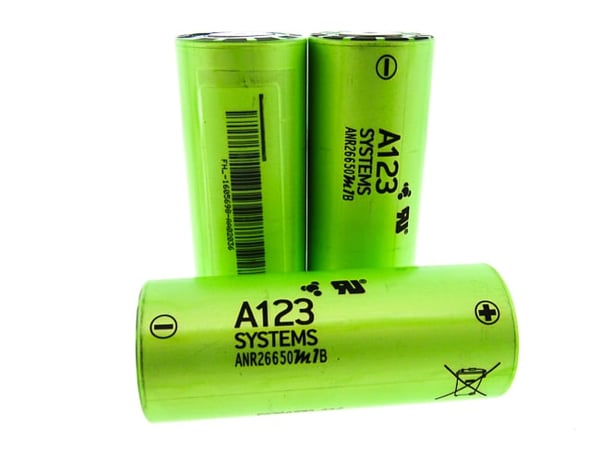
Example of a Lithium Iron Phosphate Battery Cell

Example of lithium iron phosphate battery cells.


What Are The Energy Level Differences?

There are significant differences in energy when comparing lithium-ion and lithium iron phosphate. Lithium-ion has a higher energy density at 150/200 Wh/kg versus LiFep04 at 90/120 Wh/kg. So, lithium-ion is normally the go-to source for power hungry electronics that drain batteries at a high rate.

On the other hand, the discharge rate for lithium iron phosphate outmatches lithium-ion. At 25C, lithium iron phosphate batteries have voltage discharges that are excellent when at higher temperatures. The discharge rate doesn’t significantly degrade the lithium iron phosphate battery as the capacity is reduced.

Life Cycle Differences

Lithium iron phosphate has a lifecycle of 1,000-10,000 cycles. These batteries can handle high temperatures with minimal degradation. They have a long life for applications that have embedded systems or need to run for long lengths of time before needing to be charged.

For lithium-ion, the higher energy density makes it more unstable, especially when dealing with higher operating temperature environments. It has a life cycle of 500-1,000 cycles as it can be negatively impacted based on the operating temperature of the electronics or working components.

Long-Term Storage Benefits

When it comes to storing unused batteries, it is important to pick a chemistry that doesn’t lose its charge over long periods of time. Instead, the battery should give close to the same charge performance as when it is used for over a year. Both lithium iron phosphate and lithium ion have good long-term storage benefits. Lithium iron phosphate can be stored longer as it has a 350-day shelf life. For lithium-ion, the shelf life is roughly around 300 days.

Safety Advantages Of Lithium Iron Phosphate

Manufacturers across industries turn to lithium iron phosphate for applications where safety is a factor. Lithium iron phosphate has excellent thermal and chemical stability. This battery stays cool in higher temperatures. It is also incombustible when it is mishandled during rapid charges and discharges or when there are short circuit issues. Lithium iron phosphate does not normally experience thermal runaway, as the phosphate cathode will not burn or explode during overcharging or overheating as the battery remains cool.

However, the chemistry of lithium-ion does not have the same safety advantages as lithium iron phosphate. Its high energy density has the disadvantage of causing the battery to be unstable. It heats up faster during charging as a lithium-ion battery can experience thermal runaway.

Another safety advantage of lithium iron phosphate involves the disposal of the battery after use or failure. A lithium-ion battery made with a lithium cobalt dioxide chemistry is considered a hazardous material as it can cause allergic reactions to the eyes and skin when exposed. It can also cause severe medical issues when swallowed. So, special disposal considerations must be made for lithium-ion. On the other hand, lithium iron phosphate is nontoxic and can be disposed of more easily by manufacturers.

Applications For Lithium Iron Phosphate And Lithium-Ion

Lithium iron phosphate is sought after for any electronics or machines where safety and longevity are desired but doesn’t need an extremely high energy density. Electric motors for vehicles, medical devices, and military applications where the technology will experience higher environmental temperatures. Lithium iron phosphate is also ideal for applications that are more stationary as the battery is slightly heavier as well as bulkier than lithium-ion, although it can be used in some portable technologies.

LiFePO4 may not be selected for applications where portability is a major factor due to its extra weight. For smartphones, laptops, and tablet devices, lithium-ion batteries are used. Any high-energy device that needs the best performance on the first day can benefit from the chemistry found on lithium ion batteries.

Besides looking for the right energy sources based on portability, safety and energy density, manufacturers also must consider the costs during the production of electronics as well as during disposal. Many manufacturers will select lithium iron phosphate as the cheaper battery alternative. The batteries cost less due to the safer iron phosphate chemistry as manufacturers don’t have to spend more money to recycle the materials.

Lithium Offering A Range Of Benefits

Advances in battery technologies has placed lithium chemistry at the head of the pack for being the best power source for high energy use devices that are portable. It’s long shelf life and the benefit in providing a continuous source of power over long periods of time is why both lithium-ion and LiFePO4 are reliable alternatives.

Currently, lithium batteries are still on the pricey side when compared to nickel metal hydride and nickel cadmium batteries. Yet, the long life of lithium batteries can equal out the initial high costs. For manufacturers trying to decide whether lithium-ion or  LiFePO4 will be ideal for applications, consider these key factors:

  • Highest energy density: lithium-ion
  • Good energy density and lifecycle: LFP
  • Stable chemical and thermal chemistry: LFP
  • No thermal runaway and safe when fully charged: LFP
  • Portability and lightweight characteristics: lithium-ion
  • Long life: lithium iron phosphate and lithium-ion
  • Low costs: LFP

Also, take the operating environment into serious consideration as well as any vibration issues that may be experienced. These instances may influence a manufacturer’s choices as the chemistry stability that lithium iron phosphate offers are superior than that of lithium-ion.


The Chauvin Arnoux Group in association with Nocheski puts all its know-how at the service of the prevention of the Covid 19 pandemic in Ghana

Measuring devices, metrology and low temperature sensors … the Chauvin Arnoux group offers a complementary offer to meet the health prevention challenges of today and tomorrow: Measure and analyze the quality of ambient air, identify potential carriers of ‘a Covid 19 Virus with infrared, control the temperature of vaccine storage freezers using low temperature probes.

WATCH VIDEO

Analyze the ambient air

The measurement of indoor air quality is essential to fight against the spread of Viruses, in particular that of COVID 19, in a building (schools, nurseries, offices, seminar rooms, workshops, public transport, hospitals, etc.) . At the heart of this prevention strategy, “measurement” and its analysis tools take on their full importance.

Fighting Covid 19 with ca 1510 Chauvin Arnoux

The CA 1510 portable air analyzer from CHAUVIN ARNOUX, very efficient in closed places, instantly records air particles according to standard thresholds and. It alerts by sound and “red screen” in the event of non-compliance with air quality criteria based on the CO2 level, temperature or humidity level or even the combination of the three physical quantities measured (CO2, temperature and relative humidity). Natural or artificial ventilation in confined spaces also plays a role in the spread of Covid 19 Viruses. In this respect, in addition, the CA 1227 thermo-anemometer has all the useful functions for measuring speed and air flow. Essential information to optimize the good ventilation of rooms.


Identify potential carriers of a Covid 19 Virus

In prevention, the measurement of potential indicators of disease such as fever are also provided by thermometers and thermal body cameras. The portable thermal camera CA 1900, easy to use, with immediate results and in complete safety through contactless distance, is one of the new sanitary devices to identify any person with too high a temperature and thus preventively fight against the risks of transmission of the disease.

Store vaccines

As part of the storage of the Covid 19 vaccine, the MANUMESURE company supports professionals in mapping their freezers at -80 ° C in COFRAC, intervening directly and quickly on site. PYROCONTROLE offers a range of low temperature (-80 °) temperature probes essential for players in the “Covid vaccine” sector; logistics (storage and transport), hospitals, pharmacists, doctors or even manufacturers of freezers …

Fighting Covid 19 with Chauvin ArnouxThe Chauvin Arnoux Group thus puts all its know-how, its adapted measuring devices and its metrology services at the service of pandemic prevention, to fully play its role in health situations such as the one we are experiencing today. For further inquiries on how to order these fine products in Ghana and the West Africa Region du contact Nocheski  on +233303211743 +233244270092 (Whatsapp) or email [email protected]


Ever heard of Solar Power as a Working-From-Home Perk? Installing solar power systems is already a tedious process for homeowners, and with many of us working and learning remotely, we’re too distracted to get started. Those renting or living in states where policies have made solar power a no-go can forget about it — lower bills due to solar are a pipe dream. But as many companies scramble to keep their employees motivated and rethink perks while their employees work from home, a Washington, D.C.-based startup says it has a solution.

Arcadia describes itself as the first nationwide “digital utility” in the U.S. Since its founding in 2014, the company’s platform is now available in all 50 states and with more than 100 power utilities. Users can acquire a solar power subscription from Arcadia, buy as little as one solar panel or more, and see the results as a credit on their monthly utility bills.

Therein lies an opportunity for a company’s virtual human resources desk to offer a new benefit to employees.

It’s true that we’ve seen a decrease in emissions worldwide due to the novel corona virus pandemic; how much of a reduction varies by the sources consulted. But here’s the problem for companies: For those that are tabulating their emissions as part of their sustainability or environmental responsibility strategies, many of those emissions have simply shifted from the properties they own or lease to their employees’ individual homes. Solar power can help solve that problem.

After all, many individuals’ utility bills have bumped upward, as we’re leaving our devices charged and air conditioning units running with greater frequency — not to mention the fact we’re using our household appliances more (yes, opening that fridge door constantly as a procrastination tactic adds more to your utility bill in the long term). But with working from home becoming the reality for many through 2021, companies now have the chance to offer employees financial relief while swatting away some of their own emissions.

In a recent interview with Fast Company, Arcadia CEO Kiran Bhatraju said the company’s corporate clients so far include McDonald’s, SkySpecs and CustomerFirst Renewables. But with more companies saying that working from home for the most part ended up becoming a net positive after the initial shell shock, watch for Arcadia to win more clients as remote work is redefining the very notion of “perks.”

In Ghana, where the Corona virus has increased working  from home options for many employees especially in the banking sector. Nocheski has therefore developed  special packages solar packages at very competitive prices. Call 0244270092 for more information


Low cost, large-scale Battery  storage is the key to accelerating the renewable energy revolution, and now shrimp have been enlisted in the cause. The aim is to push down the cost of flow batteries by using bio-based materials such as shrimp shells. That would help ramp up the transition   out of fossil fuels and into clean power, thus saving the planet in time to avert a climate catastrophe.

Scientists led by MIT have suggested chitin, a carbon and nitrogen-rich material made from waste shrimp shells, could produce sustainable electrodes for vanadium redox flow batteries and other energy storage technologies.

Expert projections indicate a potential annual revenue of $2 billion (€1.8 billion) from shrimp farming in Ghana, which in 2015 had excited the country’s President John Dramani Mahama, who foresees it overtaking incomes from oil and gas if successful.

Thank you, shrimp. Wait, what is a flow battery?


Shrimp (May) Be The Key to Energy Storage That Flows

We’ll get to that flow battery thing in a minute. First let’s clarify the news about shrimp shells and energy storage, which has been zooming all over the Intertubes in recent days.

The news involves research published in April at ACS Sustainable Chemical Engineering under the title, “Exploration of Biomass-Derived Activated Carbons for Use in Vanadium Redox Flow Batteries.”

The research team did not exactly determine that shrimp shells are the best bio-based material for flow batteries. What they did was compare shrimp shells to pine wood, in order to develop a method for determining the performance of a wide variety of bio-based materials and develop a general set of design principles.

Got all that? Good! Shrimp could still come out on top, but shrimp shells are just one of many bio-based sources that could be used to produce the activated carbon used in flow batteries.

The bio-based approach is relatively new, so before anybody skips to the front of the line, there needs to be “a systematic approach to advancing biomass-based functional materials for use in energy applications,” as the research team explains.

If you know your atoms, you know what the team means when they conclude that “electrochemically accessible surface area, rather than the heteroatom composition” is a more effective representative of the material’s performance.

Spoiler alert: surface area is a big deal in energy storage performance.

Why Shrimp Shells & Energy Storage Go Together Like Rice & Beans

The big question is why shrimp shells for energy storage, and the answer is chitin. Pronounced KY-tin, chitin is found in the exoskeletons, beaks, scales, and other hard parts of insects and aquatic creatures, as well as the cell walls of fungi, with shrimp and crab being the most common sources.

Chitin is already commonly used for edible film and other food products. It also pops up in biomedical and pharmaceutical applications.

As a large-scale byproduct of the food processing industry, chitin is cheap, abundant, and available practically all over the world. In other words, perfect for a world in search of low cost, sustainable energy storage.

Chitin has been a wallflower in the clean tech field, but it lately it has been emerging as a sustainable alternative to petrochemicals, and there have been hints that it could be used to make solar cells.

About That Flow Battery…

So, flow batteries. For those of you new to the topic, flow technology has been around for a while, but it has gained new significance in the age of decarbonization because it can provide for large scale, long duration energy storage at a relatively low cost.

Shrimp to Spark Flow Battery Storage RevolutionLithium-ion batteries are still the gold standard for energy storage, but they only last for a few hours. In order to integrate more wind and solar into the grid, you need energy storage technology that costs less and is more flexible and resilient, and is capable of handling grid-scale operations.

Flow batteries fit the bill. The basic idea is that two specialized liquids can generate an electrical current through a chemical reaction, when they flow adjacent to each other. Typically they are separated by a thin membrane, though researchers have experimented with formulations that do not require one.

Membrane or not, the two liquids can be stored indefinitely in their own tanks, of practically any size. Aside from providing for large-scale storage, the setup does not lose capacity over extended down time, as is the case with conventional batteries.

The US Department of Energy is all over flow batteries as a sustainable replacement for centralized, fossil fuel power plants. The technology is part of the agency’s broader push for large scale, long duration energy storage.

Energy Storage, Now With Vanadium (Not Vibranium)

As you may surmise, flow batteries involve two key challenges. One is how to ramp up the efficiency of the chemical reaction between the two liquids, while keeping costs down. That’s where the new chitin research comes in (for those of you keeping score at home, the research team includes scientists from both MIT and Tufts).

The other challenge is to formulate the optimal liquids for enhancing the reaction. The chitin research team settled on the all-vanadium redox flow battery formulation.

That’s vanadium, not vibranium. Both are metals, but only one actually exists outside of the Marvel Universe.

Our friends over at the Energy Department are quite interested in the all-vanadium formulation. Back in 2012, the agency discussed the pros and cons.

“There are many kinds of [Redox Flow Battery] chemistries, including iron/chromium, zinc/bromide, and vanadium,” the Energy Department explained. “Unlike other RFBs, vanadium redox flow batteries (VRBs) use only one element (vanadium) in both tanks, exploiting vanadium’s ability to exist in several states.”

The one-element solution enables VRBs to avoid cross-contamination issues, which is a significant problem for other chemistries.

That doesn’t mean it’s all smooth sailing for VRBs, though.

“Sulfuric acid solutions, the electrolyte used in current VRBs, can only hold a certain number of vanadium ions before they become oversaturated, and they only allow the battery to work effectively in a small temperature window,” said the Energy Department.

“The low energy densities and small operating temperature window, along with high capital cost, make it difficult for the current VRBs to meet the performance and economic requirements for broad market penetration,” the Energy Department summed it up.

That didn’t stop New York City from dabbling in the technology back in 2014, in a project featuring vanadium technology developed by the company CellCube.

Meanwhile, the Pacific Northwest National Laboratory has been among those on the prowl for improvements to the technology, and the lab has come up with new energy storage chemistries that help keep costs down while addressing the energy density and temperature issues.

Last year the Energy Department surveyed emerging grid-scale energy storage options and noted that redox flow batteries “appear to be well positioned” due to the rapid pace of improvement in the technology.

As one indicator of stepped-up activity in the vanadium flow battery field, earlier this year the US company Avalon  joined with redT Energy of the UK to form Invinity Energy Systems, which bills itself as “the world’s leading vanadium flow battery company.”


Introducing Tesla Ambulance. powered by Victron Energy .Typically an ambulance is a medically equipped vehicle which transports patients to treatment facilities, such as hospitals.[1] Typically, out-of-hospital medical care is provided to the patient.

Have you ever wondered what you would do if your electric vehicle ran out of fuel – in the middle of nowhere? calls for Tesla Ambulance

Well, we’ve got an interesting video for you.

Lucian Popescu has driven his Tesla Model S into the mountains of Romania leaving himself insufficient power to get home again. A distributor comes to his rescue with an experimental re-charge.

Are you sitting comfortably?

Just before we begin you might be interested in a quick roundup of the setup for  Tesla Ambulance we’re about to see:

  • 3 x Quattro Inverter 10kVA are configured to recharge the vehicle with 3 Phase power. It’s not always possible to charge an electric vehicle remotely because they require a Neutral Ground which is not available on many generators or alternative power supplies – but which the Quattro inverters can be switched to provide. This arrangement provides 11kWh – the standard ‘maximum’ charge acceptance rate for the Tesla AC inlet – but wait, we’re in for a surprise.
  • 4 x 25.6V Lithium Batteries which between them store 20kWh.
  • VE Bus BMS protects the battery during charge/discharge cycles
  • Cerbo GX ties everything together; and we get a look at the neat GX Touch 50 display in action.

The video saves the best for the end with a sneak preview of an early prototype of the Victron Car Charger – the EV Charging Station. Capable of providing 22kWh – electric car charging just came home. At this rate an hour of charge will provide up to 90 miles (145 km) of range; and a typical electric vehicle battery can be taken from empty to full in around 5 hours.

In other news,Emergency service giant Falck, a Denmark-based first responder and ambulance operator, wanted to test if they could make a zero-emission emergency service vehicle. To do this they turned a roomy, fast, and long-range Tesla Model X into an ambulance.

The company operates in over 35 countries worldwide. It provides ambulance services in close cooperation with the national authorities. Falck is today the world’s largest international ambulance operator with more than 5000 vehicles around the globe, but very few are powered by electricity. It makes complete sense that they would try to implement the electric vehicle era in the fleet.


Ghana’s Plastic manufacturer Miniplast will buy electricity from a 704 kW grid-connected solar array owned and operated by Norwegian  renewable energy developer Empower New Energy AS.

Norway-based Empower New Energy has secured one of Africa’s first power purchase agreements (PPAs) for the supply of solar electricity.

Empower, which has a focus on  renewable energy project deployment in sub-Saharan Africa, said Ghanaian plastic manufacturer Miniplast Limited has agreed to buy electricity from a 704 kW rooftop solar array to be installed on its manufacturing and recycling facility in Accra, in the Ghanaian capital.

The plant will be installed and operated by Stella Futura Ltd under a power sales agreement signed between the three partners,” Empower New Energy said. “The investment will be made through a local project company majority owned by Empower Invest, the impact investment fund managed by Empower New Energy.” Stella Futura will act as EPC contractor for the project.

Terms

The financial terms of the PPA were not revealed.

The rooftop installation is slated to become operational in July.

bilateral solar PPA in Africa was signed in January 2019 between Egyptian solar company SolarizEgypt and the Arabian Cement Company.

Renewable Energy :Ghana’s first bilateral solar PPA to be set up on factory rooftops of Miniplast in Spintex Industrial Area of Accra city, the 704 kW system is planned to be grid connected by July 2020. It will help the manufacturer reduce its consumption of diesel to power its factories while bringing down its electricity costs.

“We’re excited to install one of the largest industrial and commercial solar PV systems in Ghana,” said Nadim Ghanem-Pares, Deputy Managing Director of Miniplast Limited. “Furthermore, this will be a flagship project to promote the use of renewable energy within the Spintex Industrial enclave of Accra.” Empower Invest’s Empower New Energy (EmNEW) is funded by Norway’s development fund for emerging markets Norfund, and European Union’s first electrification financing initiative, Electrify, among others.

Ghana is increasing efforts to raise the share of renewables in its electricity mixUnder its energy strategy, the nation wants 2.5 GW of renewable energy generation capacity – probably including hydroelectric – by 2030. Ghana had just 64 MW of solar capacity at the end of 2018, according to International Renewable Energy Agency statistics.

Credit

This article was originally written by Emiliano Bellini.He joined pv magazine in March 2017. He has been reporting on solar and renewable energy since 2009.

A solar-powered  farm in Mali, West Africa, is stretching the boundaries of what’s possible. In a landlocked country well-known for producing Cotton, Rice Millet and Corn, the Complex Agro Industrial de Baragnouma produce fish – at a rate of 5 tons a day.All powered by Victron Energy and Fronius…

In order to maintain conditions in which the fish can thrive water has to be continually filtered and oxygenated. Water treatment takes a lot of power – at the Baragnouma complex that power is provided by solar energy from Fronius and victron.

It seems fatuous to say that the reliability of their remote power plant is paramount …but if the power were to fail for just 30 minutes, the fish would die.

It was decided at the outset, in 2014, that the farm would incorporate solar energy power provision to the greatest possible extent – though few could have foreseen the scale of its success. Ninety-eight per cent of the power requirement is met by solar energy, back-up generators providing the other two percent.

victron Energy & fronius: solar -powered agriclture in Mali
DCIM100MEDIADJI_0032.JPG

In fact there are seven off grid solar-powered electrical installations at the Complex Agro Industrial de Baragnouma which provide inexpensive sustainable energy not only for their pisciculture but also for: Chicken, Dairy, Fruit and Vegetables; a factory which produces animal feed; workers houses; and two small offices.

Fortunately sunshine is very dependable in Djoliba which is 40km from Mali’s capital, Bamako. Their investment over 6 years has exceeded a million dollars – yet these investments are lower than the cost of the diesel which would otherwise have been used. And the solar installations save more than 400 tons of CO2 emissions annually.

The carefully orchestrated infrastructure includes a Fish nursery for 20,000 Alvins per cycle of production, which are reared in 8 ponds. There are a further 14 ponds each of 1000m² for the specie Clariidae. Thirteen much larger ponds provide the habitat for rearing Tilapia. There is a recycled water requirement of 14,570 cubic metres per day with pumps working at up to 180 cubic metres per day; and top-up pumped from boreholes.

victron Energy & fronius: solar -powered agriclture in Mali

The seven Off-Grid Systems have a total capacity of 520kW.  Generating a similar amount of energy using diesel would cost around $260,000 a year …add to that the cost of maintenance, transport for fuel, and depreciation of the generators and it’s easy to see how the cost savings, and power security make the solar option so desirable. And the farm operates silently – which is a bonus for the 100 or so employees who are all fully engaged with the project.

The installation was carried out by Sonikara Solar Electro – overseen by company CEO and Founder Mouctar Doucoure. Working with the support of Victron staff, it is a ringing endorsement of the technological ability of Sonikara that they have been awarded the maintenance contract to oversee this huge installation for the next five years – monitoring and maintaining the system so that it runs without missing a beat.

victron Energy & fronius: solar -powered agriclture in Mali
Anco van Bergeijk (support engineer for Victron in Africa) Mouctar Doucoure (CEO and founder of Sonikara Solar)

The Biggest standalone Victron/Fronius installation provides 3-phase power to the fish and chicken food factory – which can be seen in the video below. It employs:

In 2018 a dairy was added, together with a food processing factory. Last year saw the construction of some impressive looking greenhouses for vegetable production. As each success is chalked up so more new ideas are tried the owner has ever greater plans for the future of this diverse farming model.

The latest installation powers the greenhouses, and provides water treatment and pumping, together with a heat regulation system. It employs:

victron Energy & fronius: solar -powered agriclture in Mali

Other installations in this large farm complex provide:

    • 5kVA for the Egg incubators (poultry)
    • 10kVA for the Poultry farm
    • 60kVA for the Fish nursery and lab
    • 10kVA for the Offices and Conference suite
    • 10kVA Further offices
    • 3kVA for Employees houses
    • 3kVA for the Cattle farm

Victron products have a broad range of compatibility with third-party manufactured equipment. Fronius inverters and BYD’s Iron Phosphate chemistry batteries – chosen here for their scalability, and their ability to operate in temperatures of up to 55°C – all work seamlessly with Victron Solar Charge controllers, Inverters, and with our data-comms controller the Color Control GX (CCGX).

Using Victron’s Remote Management platform (VRM), the CCGX provides at-a-glance remote monitoring and management so that the Sonikara team can perform interventions whenever required, from their own offices.

Victron provides training and support in West Africa (and indeed all over the world) to ensure that the skills are available for projects of this scale to be built, and offers continued training to equip solar engineers with the necessary expertise.

victron Energy & fronius: solar -powered agriclture in Mali

The positive social and economic advantages are substantial and far-reaching. The farm provides fresh fish, chicken, milk and vegetables to the national and local market of Mali, Bamako.  In addition to the farm’s 100 employees, it provides work for local traders, and trickle-down benefits for other commercial operators.

Mouctar Doucoure said: The challenges of an off-grid electrical project of this size is to constantly adapt to growth, and to educate all involved. We accomplished this by creating local expertise and by expanding the systems step-by-step. The quality of wiring installations, batteries, and the system design was tested after each phase. Also; all the systems can be constantly monitored online.

Let’s take a look at the site through this informative video. It’s interesting to hear a word or two about how the video was made. Seizing the opportunity to provide experience for some Video School graduates in Mali, it was decided to commission them to film and produce the promotional video below.

Much was learned and the result by Israel Oron and his colleagues – former students from Conservatoire des arts of Bamako – is excellent:


The ‘win-win’ success of this project which creates useful employment; increases education; produces healthy food in a noise and pollution-free environment; as well as reducing costs and reduces carbon emissions – is that it becomes a beacon showing the way ahead …demonstrating how technology can be harnessed for the future benefit of local communities.


All images: Photos/Film: B-Twien Clicks | Film & Photo or Ewien van Bergeijk – Kwant.


WhatsApp Us Now!