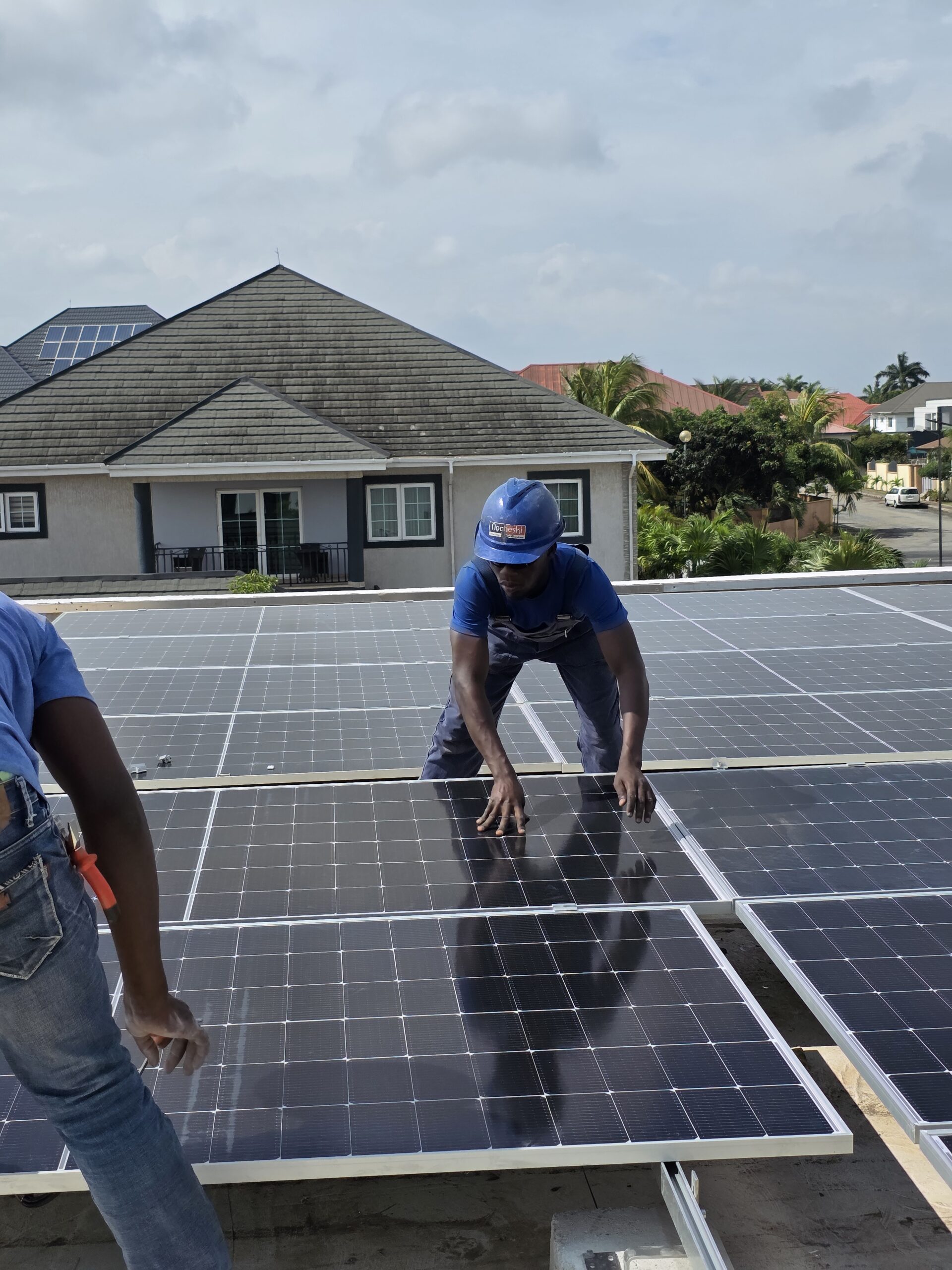
Why Solar Power Systems Fail

When people search for why solar power systems fail, they are usually not asking an academic question.
They are asking because something has already gone wrong.

Batteries no longer last through the night.
Inverter systems trip under normal use.
Generators are running more than expected.
Confidence in solar power is lost.

In most cases, these problems are not caused by solar panels or battery technology.
They are caused by poor solar power system design.

Solar panels generate electricity reliably.
Modern inverter systems are robust.
Battery energy storage systems perform predictably when designed correctly.

Yet solar power systems continue to fail — not randomly, but predictably.

The common thread is design decisions made before installation:

  • load profiling based on estimates instead of measurements

  • battery storage sized without understanding night-time demand

  • inverter systems selected without accounting for peak loads

  • no allowance for environmental conditions or future growth

This article explains why solar power systems fail, what those failures have in common, and how proper system design prevents them.

WHY POORLY DESIGNED SOLAR POWER SYSTEMS FAIL IN GHANA

(And Why the Technology Is Usually Not the Problem)

Introduction: When “Solar Failed,” What Actually Failed?


When people say “solar didn’t work,” they are rarely describing a failure of solar technology.

In most cases, they are describing the failure of a poorly designed solar power system.

Solar power systems fail predictably, not randomly.
And those failures are almost always traced back to decisions made before installation — during system design.

Understanding this distinction is critical for anyone relying on solar power for homes, businesses, healthcare facilities, or institutions.


1. Solar Panels Are Not the Problem

Solar panels are mature, reliable technology.
They convert sunlight into electricity with predictable performance when installed correctly.

However, solar panels alone do not deliver reliable power.

Reliable electricity comes from a complete solar power system, which includes:

  • solar panels

  • an inverter system

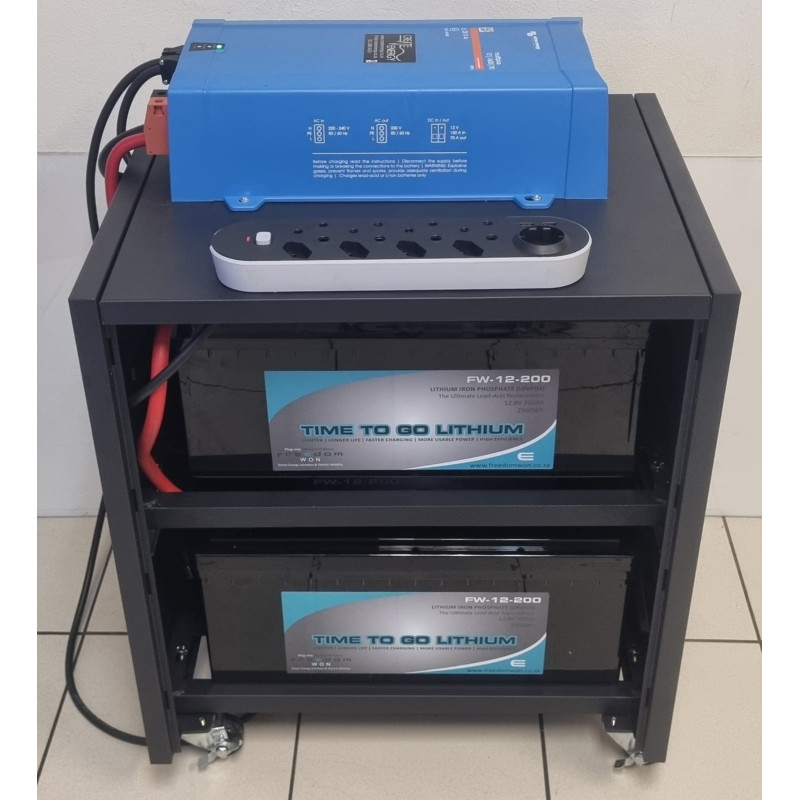
  • a battery energy storage system (battery backup)

  • protection and control equipment

When a system fails, the issue is rarely the solar panels themselves.
The issue is how the system around them was designed.


2. Failure Begins With Guesswork, Not Measurement

One of the most common causes of failure is inadequate load profiling.

Instead of measuring how electricity is actually used, many systems are designed using:

  • rough estimates

  • nameplate ratings

  • assumptions about behavior

This leads to predictable errors:

  • inverter systems that cannot handle peak demand

  • battery storage that cannot supply night-time loads

  • systems that collapse under normal usage

A solar power system must be designed around real load behavior, not averages or guesses.

@nocheski

The failure of Solar power systems in Ghana begins with guesswork, NOT measurement .one of the most common causes of failure is indequate load profiling. @Chauvin Arnoux UK @Victron Energy @BYD @CA Messtechnik

♬ original sound – NOCHESKI SOLAR


3. Undersized Battery Energy Storage Systems

Battery energy storage is one of the most misunderstood parts of a solar power system.

A battery energy storage system (BESS) must be sized based on:

  • night-time energy demand

  • duration of autonomy required

  • critical vs non-critical loads

  • realistic depth of discharge

  • future growth

When battery storage is undersized:

  • power does not last through the night

  • generators are forced to run excessively

  • batteries degrade prematurely

  • confidence in solar power is lost

This is not a battery problem.
It is a design problem.


4. Inverter Systems Selected Without Context

Inverter systems are often selected based on:

  • headline power ratings

  • price

  • availability

Instead of:

  • surge requirements

  • motor starting currents

  • simultaneous load behavior

  • environmental conditions

An inverter system that is not designed for real operating conditions will:

  • trip under normal load

  • shut down during peaks

  • reduce system reliability

Again, the failure is not the inverter technology.
It is the absence of proper system design.


5. Ignoring Environment and Operating Conditions

Solar power systems do not operate in laboratories.

They operate in:

  • heat

  • dust

  • humidity

  • unstable usage patterns

  • environments with limited maintenance capacity

Design that ignores these realities leads to:

  • accelerated wear

  • overheating

  • frequent faults

  • shortened system life

A well-designed solar power system accounts for environment from the start, not after failure.


6. Price-Driven Design Is the Fastest Path to Failure

When the primary design constraint is price, reliability is always compromised.

This usually results in:

  • reduced battery storage

  • minimal protection

  • no allowance for growth

  • no redundancy for critical loads

The system may appear functional initially, but degradation begins immediately.

Lower upfront cost often produces higher lifetime cost.


7. Why Two Systems With the Same Solar Panels Perform Differently

It is common to see two installations using the same solar panels with completely different outcomes.

The difference is not the solar panels.
The difference is system design quality.

Design determines:

  • how long battery storage lasts

  • how often generators run

  • whether critical loads are protected

  • whether the system scales with demand

  • whether power remains reliable over time


8. Solar Power Systems That Work Are Rarely Dramatic

Well-designed solar power systems tend to be unremarkable.

They:

  • do not trip frequently

  • do not require constant intervention

  • do not surprise operators

They simply deliver power — day after day.

This is not luck.
It is engineering.


9. How to Avoid Solar Power System Failure

Reliable solar power systems share common characteristics:

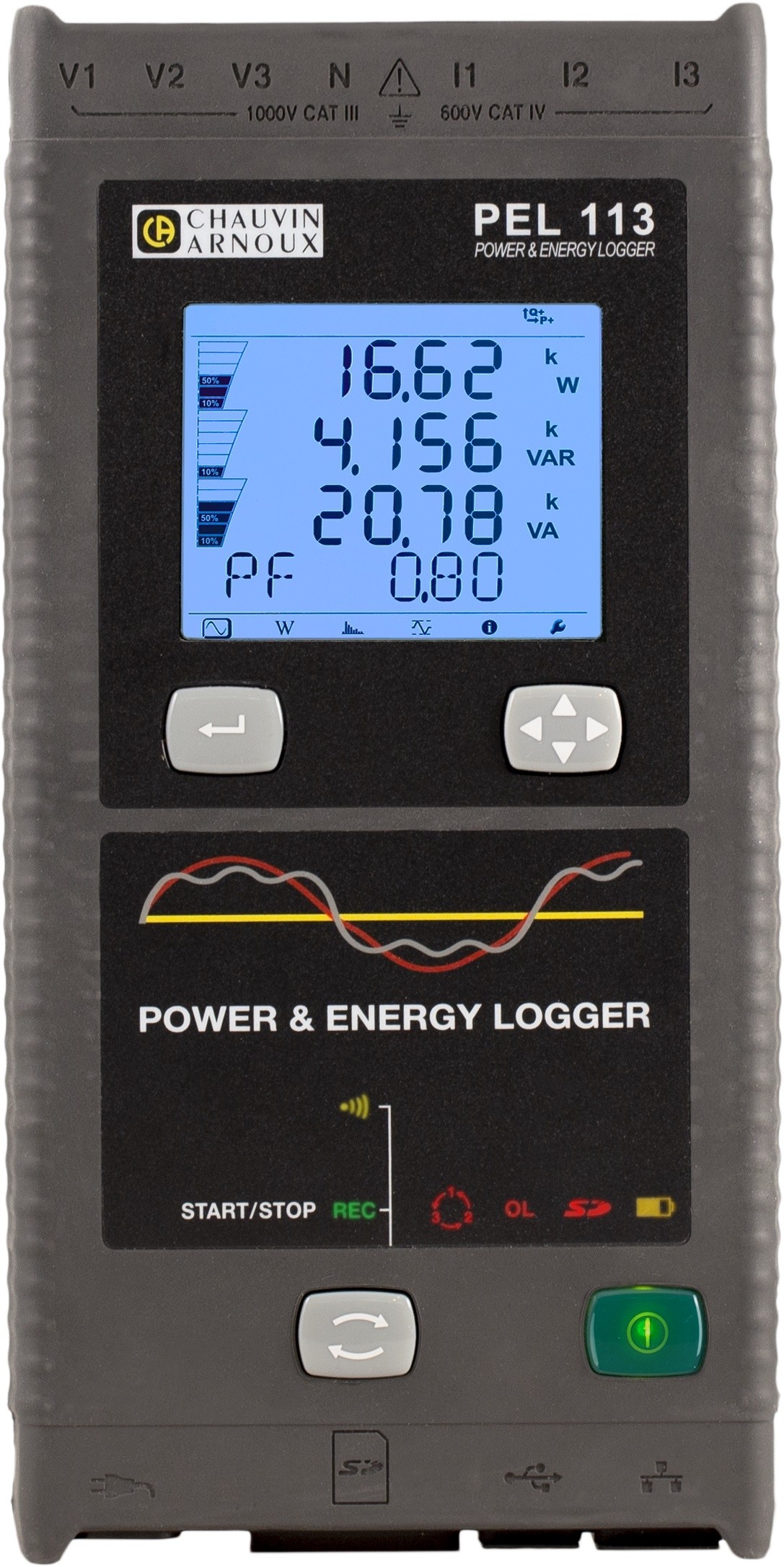
  • The PEL 113 measures and records all the power and energy values.
    It can be used wherever there is electricity:
    • electricity generator: renewable energies, thermal energy, etc.
  • correctly sized battery energy storage

  • inverter systems matched to real demand

  • protection designed for real-world conditions

  • margins for growth and misuse

Design precedes equipment selection — not the other way around.


10. The Right Question to Ask

When a solar power system fails, the most important question is not:

“Why did solar fail?”

The correct question is:

“Was this solar power system ever designed to succeed?”


Conclusion: Solar Technology Works. Poor Design Does Not.

Solar power is not experimental.
It is proven, reliable technology.

Failures occur when system design is treated as optional.

At Nocheski Solar, we design solar power systems for:

  • real usage

  • real environments

  • real consequences

Because solar panels generate electricity —
but only a properly designed solar power system delivers reliable power.


Solar Panels in Ghana: From Polycrystalline to TOPCon and HJT Explained Simply

Solar energy adoption in Ghana has grown rapidly over the last decade. Rising electricity tariffs, unstable grid supply, frequent outages, and the need for energy independence have made solar power a smart investment for homes, businesses, schools, and industries.

Yet one major challenge remains: solar panel technology is evolving faster than public understanding.

At Nocheski Solar, we meet many clients who ask:

  • Is monocrystalline still good?

  • What is TOPCon?

  • Is bifacial better for Ghana’s climate?

  • Is HJT worth the extra cost?

This article explains the evolution of solar panel technology, step by step, in simple, practical language, with a clear focus on what works best in Ghana.


1. Where It All Started: Polycrystalline Solar Panels

Polycrystalline panels were once common across Ghana because they were affordable and widely available.

Key Characteristics:

  • Made from multiple silicon crystals

  • Blue, grainy appearance

  • Lower efficiency (15–17%)

  • Require more roof or land space

Why They Are Becoming Obsolete:

In Ghana, roof space is often limited, and high temperatures reduce panel performance. Polycrystalline panels simply cannot deliver enough power efficiently under these conditions. Today, they are rarely recommended for serious solar projects.


2. The Industry Standard: Monocrystalline Solar Panels

Monocrystalline panels quickly replaced polycrystalline panels due to better performance.

Why Mono Took Over:

  • Higher efficiency (18–20%)

  • Better performance in heat

  • Longer lifespan

  • Sleek black appearance

For many years, monocrystalline panels formed the backbone of solar installations in Ghana—and they still perform reliably today.

https://www.youtube.com/watch?v=8aB_GY6rxPA


3. Smarter Engineering: Half-Cut and PERC Technology

To further improve output and durability, manufacturers introduced PERC and half-cut cell designs.

What This Improved:

  • Reduced internal power losses

  • Better heat resistance (important for Ghana’s climate)

  • Improved long-term reliability

These panels marked a major step forward and are still widely installed across residential and commercial projects.


4. Understanding Bifacial Panels (Very Important)

This is where confusion often begins.

Key Point:

👉 Bifacial is not a solar cell technology. It is a panel design.

What Makes a Panel Bifacial?

  • Electricity is generated from both the front and the back

  • The rear side captures reflected sunlight from the ground

  • Uses glass on both sides, not a white backsheet

Does Bifacial Work in Ghana?

Yes—very well, especially when:

  • Installed on light-colored roofs

  • Mounted above concrete, sand, or reflective surfaces

  • Used in ground-mounted or elevated systems

Bifacial panels can deliver 10–30% more energy depending on site conditions.

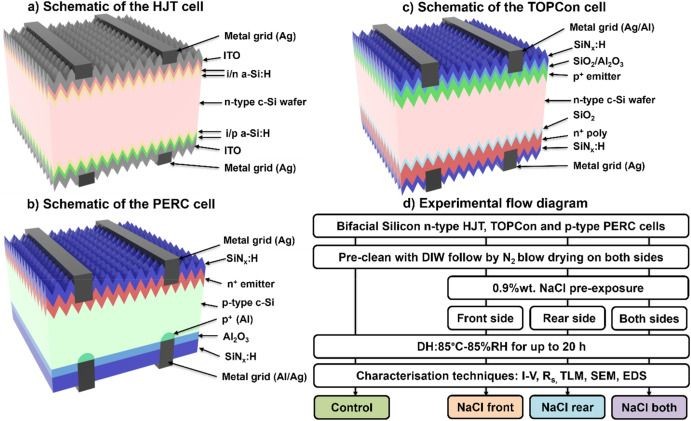
Solar Panels in Ghana: From Polycrystalline to TOPCon and HJT Explained
Solar Panels in Ghana: From Polycrystalline to TOPCon and HJT Explained in ghana

5. TOPCon Solar Technology: Built for Heat, Built for Ghana

TOPCon (Tunnel Oxide Passivated Contact) is one of the most important modern solar cell technologies.

What Is TOPCon?

TOPCon refers to how the solar cells inside the panel are engineered, not the external appearance of the panel.

Why TOPCon Is Ideal for Ghana:

  • Higher efficiency (23–24%)

  • Excellent performance in high temperatures

  • Lower degradation over time

  • Longer useful lifespan (25–30+ years)

Bigger Power, Fewer Panels:

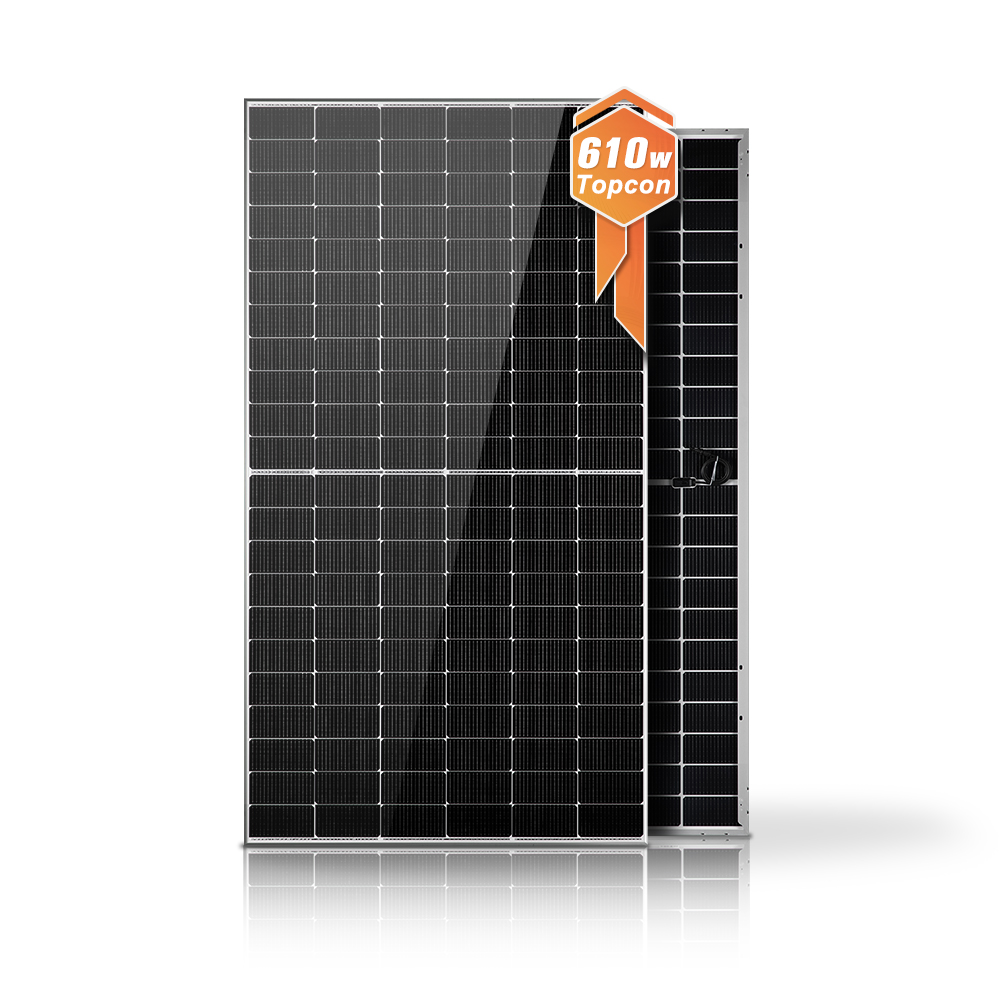
TOPCon panels are now available in 600–700W ratings, which means:

  • Fewer panels on the roof

  • Reduced mounting and wiring costs

  • More power from limited space

For homes and businesses in Ghana, this translates directly into better return on investment.


6. TOPCon + Bifacial: Maximum Energy Output

Here is the most important clarification:

You can combine TOPCon cell technology with a bifacial panel design

  • TOPCon = how the cell is made

  • Bifacial = how the panel captures sunlight

Why This Combination Is Powerful:

  • Higher base efficiency

  • Additional rear-side power generation

  • Superior performance in open, sunny environments

👉 For most solar installations in Ghana today, TOPCon bifacial panels offer the best balance of performance, durability, and value.


7. HJT Solar Panels: The Premium Technology

HJT (Heterojunction Technology) currently represents the highest level of solar panel efficiency.

Advantages of HJT:

  • Highest efficiency available

  • Extremely low degradation

  • Outstanding performance in hot climates like Ghana

Considerations:

  • Higher upfront cost

  • More suitable for premium or large-scale projects

  • Best where maximum output per square meter is critical

HJT is ideal for high-end commercial, industrial, and utility-scale projects, but may not always offer the best cost-benefit for every home.


8. Solar Panel Technology Ranking (Simplified)

From highest performance to lowest:

  1. HJT Solar Panels

  2. TOPCon Solar Panels

  3. Half-Cut Monocrystalline (PERC)

  4. Polycrystalline Panels


9. What Really Matters in Ghana

In Ghana, there are no solar panel subsidies, so the decision must be based on:

  • Long-term energy output

  • Heat performance

  • Durability

  • Space efficiency

  • Total lifetime value—not just upfront cost

Choosing outdated technology may look cheaper today, but it costs more over time through lower energy production and faster degradation.


10. Nocheski Solar’s Expert Recommendation

🔑 Technology first. Brand second.

A well-engineered modern panel will always outperform an old design—even from a popular brand.

Our General Guidance:

  • Homes & SMEs: TOPCon bifacial

  • Commercial & Industrial: TOPCon or HJT

  • Large Ground-Mounted Systems: Bifacial TOPCon or HJT


Powering Ghana’s Solar Future

At Nocheski Solar, we design solar systems specifically for Ghana’s climate, grid conditions, and energy needs.
We don’t just sell panels—we build reliable, high-performance energy solutions that deliver real value for decades.

📞 Talk to Nocheski Solar today and let’s design the right solar technology for your home or business.

Smart solar starts with clear understanding. 🌞


Solar Power as the Ultimate Work-From-Home Perk for High-Performance Employees in Ghana

As remote and hybrid work become the new normal, forward-thinking employers in Ghana are discovering a powerful truth: reliable electricity is now a productivity benefit.

With frequent power outages, rising electricity tariffs, and generator fatigue, solar power systems are fast becoming the most valuable work-from-home perk for high-performance employees in Ghana.

For companies that depend on results—not excuses—solar energy is no longer optional.


The Reality of Working From Home in Ghana Today

Remote work in Ghana faces unique challenges:

  • ECG power outages and load fluctuations

  • Rising fuel costs for generators

  • Internet downtime during blackouts

  • Missed Zoom meetings and delayed deliverables

  • Reduced productivity for remote staff

For top-performing employees, these disruptions directly affect output, deadlines, and morale.

This is why companies are now investing in home solar power systems in Ghana as a strategic productivity solution.


Why Solar Power Is a Game-Changer for High-Performance Employees in Ghana

1. Guaranteed Power for Remote Work in Ghana

A professionally installed solar system with battery storage ensures uninterrupted electricity for:

  • Laptops and desktop computers

  • Wi-Fi routers and modems

  • Home office lighting

  • Air conditioners and fans

  • Printers and monitors

With solar, work continues even when the national grid fails.

In Ghana’s work-from-home economy, uptime equals income.


2. Solar Power as a Premium Employee Benefit in Ghana

Unlike cash bonuses that disappear, solar energy systems deliver long-term daily value.

Employers offering solar as a perk enjoy:

  • Increased employee loyalty

  • Reduced remote work disruptions

  • Stronger employer branding

  • Higher staff satisfaction

For employees, solar means:

  • Lower electricity bills

  • Zero generator stress

  • Improved home comfort

  • Better work-life balance

This makes solar one of the most powerful non-cash employee incentives in Ghana.


3. Improved Mental Wellness & Focus

Unstable power creates anxiety, stress, and frustration—especially for professionals handling deadlines, virtual meetings, and global clients.

Solar power eliminates:

  • Power outage anxiety

  • Generator noise and fumes

  • Productivity interruptions

  • Fear of missing critical meetings

Stable electricity = clear focus and peak performance.


4. Talent Retention in a Competitive Ghanaian Job Market

Top professionals in IT, finance, marketing, engineering, and consulting are in high demand.

When an employer installs home solar systems for key staff, it sends a powerful message:

“We invest in your productivity and well-being.”

This significantly reduces staff turnover and strengthens long-term commitment.


Solar Power as a Strategic HR & ESG Policy in Ghana

Leading organizations in Accra, Tema, and across Ghana are now:

Solar power supports:

  • Corporate sustainability targets

  • Carbon footprint reduction

  • Energy independence

  • Business continuity planning


Why Nocheski Solar Is the Trusted Solar Company in Ghana for Remote Work Solutions

Nocheski Solar is not just another solar installer in Ghana.

We are specialists in performance-driven solar power systems, with:

  • Over 20 years of experience in Ghana’s solar industry

  • Expertise in residential and commercial solar installations

  • Premium equipment from Victron Energy, Fronius, BYD, and other global leaders

  • Deep understanding of Ghana’s power challenges and load profiles

We design systems specifically for:

  • Remote professionals

  • Executives working from home

  • High-power home offices

  • Business-critical energy needs


Customized Solar Power Systems for Work-From-Home Professionals in Ghana

Nocheski Solar designs tailored solar solutions for:

  • IT professionals and software developers

  • Accountants and finance professionals

  • Digital marketers and content creators

  • Engineers and consultants

  • Corporate executives and managers

Our systems are optimized for:

  • Clean, stable power for sensitive electronics

  • Long battery autonomy

  • Future expansion

  • Maximum return on investment


Solar Power in Ghana: A Productivity Investment That Pays for Itself

For employers:

  • Increased productivity

  • Fewer missed deadlines

  • Stronger talent retention

  • Reduced operational risk

For employees:

  • Energy independence

  • Lower monthly electricity costs

  • Better working conditions

  • Peace of mind

Solar power is no longer a luxury—it’s a business performance tool.


The Future of Remote Work in Ghana Is Solar-Powered

As Ghana’s workforce continues to embrace remote and hybrid work, solar energy will define the most successful organizations.

Companies that act now will:

  • Attract elite talent

  • Retain high performers

  • Build resilient, future-ready teams


Talk to Nocheski Solar Today

If you are an employer, HR manager, or high-performance professional looking for reliable solar power systems in Ghana, Nocheski Solar is your trusted partner.

📞 Contact Nocheski Solar – Ghana’s Performance-Focused Solar Experts
🌞 Power productivity. Reward excellence. Go solar.


Victron SmartSolar MPPT Charge Controllers in Ghana: Models, Sizing & Engineering Guide

Updated September 2026

Choosing the right solar charge controller is one of the most important design decisions in a battery-based solar power system. An incorrectly sized controller can restrict solar production, compromise charging performance, cause nuisance shutdowns or, in the worst case, expose equipment to voltages and currents outside its operating limits.

For homes, businesses, telecom installations, remote facilities and professionally engineered off-grid or hybrid solar systems, Victron Energy SmartSolar MPPT charge controllers provide a highly flexible platform for converting energy from a solar PV array into controlled battery charging.

At Nocheski Solar, we supply, design, install, commission and support Victron-based solar and battery systems in Ghana. Our approach goes beyond simply selecting a controller by wattage. Correct MPPT selection requires consideration of solar-panel electrical characteristics, array configuration, battery voltage, battery chemistry, charging requirements, environmental conditions and the architecture of the complete energy system.

This guide explains how Victron SmartSolar MPPT controllers work, what the model numbers mean, how to select the appropriate controller and what buyers in Ghana should consider before purchasing one.

What Is a Victron SmartSolar MPPT Charge Controller?

A solar charge controller sits between the photovoltaic array and the battery bank. Its job is to extract usable power from the solar panels and regulate the voltage and current delivered to the batteries.

MPPT means Maximum Power Point Tracking.

Solar panels do not produce their maximum available power at one fixed voltage throughout the day. Irradiance, temperature, shading and other operating conditions continually change the panel’s optimum operating point.

A Victron SmartSolar MPPT continuously tracks this point and converts the available PV power into the voltage and current required to charge the battery efficiently.

Victron states that its ultra-fast MPPT technology can harvest up to 30% more energy than PWM charge controllers under relevant operating conditions, with the advantage particularly noticeable when solar irradiance changes.

This should not be confused with saying that an MPPT is simply “30% more efficient.” The actual advantage depends on the PV array, battery voltage, weather, operating conditions and system design.

Why MPPT Is Usually Preferable to PWM

A traditional PWM controller effectively forces the PV array to operate much closer to battery voltage. That can leave part of the available solar-panel power unused.

An MPPT controller operates the array closer to its optimum power point and then performs the required DC-to-DC conversion for battery charging.

This also gives system designers considerably more flexibility when configuring PV strings because the array voltage can be substantially higher than the battery voltage, provided all voltage, current and equipment limits are respected.

For modern lithium-based solar systems and larger PV arrays, professional system design will therefore usually favour MPPT technology rather than PWM.

Understanding Victron SmartSolar Model Numbers

Victron’s model numbers contain useful engineering information.

Consider the SmartSolar MPPT 150/70.

The first number, 150, indicates the controller’s maximum PV open-circuit voltage class.

The second number, 70, represents the maximum battery charge current in amperes.

Similarly, a SmartSolar MPPT 250/100 belongs to the 250 V PV-input class and can deliver up to 100 A of battery charge current.

This does not mean that a designer should simply connect a PV array with a calculated open-circuit voltage of exactly 150 V to a 150 V controller or exactly 250 V to a 250 V controller.

PV open-circuit voltage changes with temperature. Correct design therefore requires the calculated maximum string Voc, including temperature effects and appropriate engineering margin, to remain within the limits specified by Victron.

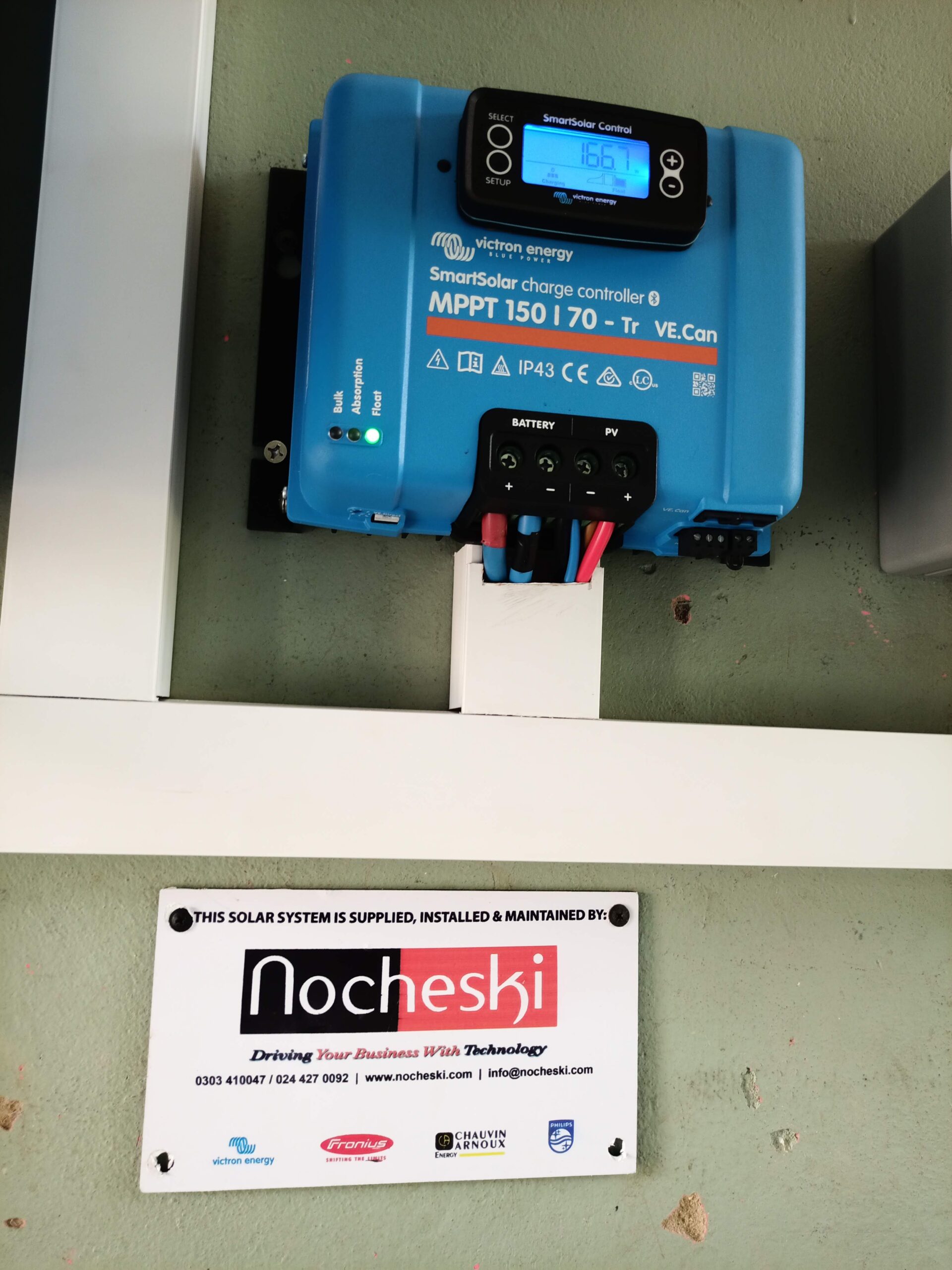
victron energy SmartSolar MPPT 150-70-Tr VE Can -LEFT
victron energy SmartSolar MPPT 150-70-Tr VE Can avaialble in Ghana

Popular Victron SmartSolar MPPT Models

The SmartSolar family covers systems ranging from small battery installations to much larger multi-controller PV systems.

SmartSolar model Maximum PV voltage class Maximum charge current Typical supported battery voltages* Example nominal PV capacity
MPPT 75/10 75 V 10 A 12/24 V 290 W at 24 V
MPPT 75/15 75 V 15 A 12/24 V 440 W at 24 V
MPPT 100/20 100 V 20 A 12/24/48 V 580 W at 24 V
MPPT 100/30 100 V 30 A 12/24 V 880 W at 24 V
MPPT 100/50 100 V 50 A 12/24 V 1,400 W at 24 V
MPPT 150/70 VE.Can 150 V 70 A 12/24/36/48 V 4,000 W at 48 V
MPPT 250/70 VE.Can 250 V 70 A 12/24/36/48 V 4,000 W at 48 V
MPPT 250/100 VE.Can 250 V 100 A 12/24/36/48 V 5,800 W at 48 V

*Exact compatibility must always be checked against the current Victron datasheet, product part number and physical product label before system design or installation. Some variants within product families can have different voltage limitations.

For example, Victron specifies the SmartSolar 250/100 VE.Can at up to 100 A battery charge current, with nominal PV power of 5,800 W on a 48 V battery system and peak conversion efficiency of 99%.

The table should therefore be treated as a selection guide rather than a substitute for engineering calculations.

How to Choose the Correct Victron SmartSolar MPPT

Correct MPPT sizing starts with the solar array and battery system, not with whichever controller happens to be available on the shelf.

At minimum, the designer should establish the solar-panel wattage, open-circuit voltage (Voc), voltage at maximum power (Vmp), short-circuit current (Isc), current at maximum power (Imp), number of panels, proposed series/parallel configuration, battery-system voltage, battery chemistry and charging-current limitations.

For example, simply knowing that a customer has “six 600 W panels” is not enough.

Six panels represent 3.6 kWp, but their correct configuration depends on each panel’s Voc, Vmp, Isc and temperature coefficient. Putting all six in series may exceed one controller’s permissible PV voltage while a different series-parallel arrangement may be acceptable.

The correct controller is therefore determined by electrical characteristics, not panel wattage alone.

PV Voltage Is Critical

Exceeding an MPPT’s maximum allowable PV open-circuit voltage can damage the equipment.

This is one of the most important reasons to avoid casual solar-system sizing based only on internet calculators or rules of thumb.

For Victron’s 150 V and 250 V VE.Can controller families, the model designation tells you the voltage class, but Victron’s manuals provide additional operating and start-up limits that must also be respected.

A professional design checks the array’s maximum possible open-circuit voltage rather than merely its normal operating voltage.

Charge Current and Battery Requirements Matter Too

The second part of MPPT selection is determining whether the controller’s charging capability is appropriate for the battery bank.

A 100 A MPPT is not automatically “better” than a 70 A MPPT.

The correct charging current depends on the PV capacity, battery-bank voltage, battery chemistry, battery capacity, battery-management system and the manufacturer’s permitted charge rate.

Oversizing components without understanding the system architecture wastes money. Undersizing them can constrain solar harvesting and battery charging.

Engineering is inconvenient like that. Numbers remain stubbornly more important than product labels.

Victron SmartSolar and Lithium Batteries

Victron SmartSolar MPPT controllers can be configured for different battery charging requirements, including lithium and lead-acid battery systems.

However, “lithium compatible” should not be interpreted as permission to connect any lithium battery to any controller with arbitrary settings.

A correctly engineered lithium installation must consider the battery manufacturer’s required charge voltages, current limits, battery management system, communications architecture and required charge-control behaviour.

This becomes particularly important in integrated Victron systems where the MPPT, inverter/charger, GX device and compatible battery BMS may exchange information to coordinate system operation.

At Nocheski Solar, we therefore treat the battery, inverter/charger, MPPT and monitoring platform as parts of one system, rather than unrelated products assembled simply because their voltage labels appear to match.

Built-In Bluetooth and VictronConnect

One of the practical advantages of the SmartSolar range is built-in Bluetooth on applicable SmartSolar models.

Using the VictronConnect application, installers and users can access operating data and configure supported parameters locally.

Depending on the model and system, VictronConnect can provide information such as PV voltage, PV power, battery voltage, charge current, charging stage, daily yield and historical performance.

This is extremely useful for commissioning, troubleshooting and routine system observation.

Bluetooth, however, should not be confused with internet-based remote monitoring.

Bluetooth Monitoring vs VRM Remote Monitoring

When a phone connects directly to a SmartSolar MPPT using Bluetooth, the user is communicating locally with the controller.

For genuine remote access over the internet, compatible Victron devices can be integrated with a GX communication device, such as a Cerbo GX, and connected to the Victron Remote Management (VRM) portal.

Victron also provides VictronConnect-Remote functionality for compatible products connected appropriately through a GX system.

This allows a professionally integrated Victron installation to be monitored from another town, another region or another country rather than requiring someone to stand beside the controller with a telephone.

For commercial, institutional and critical installations, this monitoring architecture can be extremely valuable for performance analysis, alarm management, diagnostics and technical support.

SmartSolar vs BlueSolar: What Is the Difference?

Victron offers both SmartSolar and BlueSolar charge controllers.

One of the most visible practical differences across comparable product ranges is connectivity. SmartSolar products are associated with integrated Bluetooth functionality, while BlueSolar products may require an additional communications accessory for Bluetooth access.

The precise differences depend on the individual model.

For a new system where easy commissioning and local smartphone monitoring are important, SmartSolar is often the more convenient choice.

The decision should nevertheless be based on the required electrical specifications, communications architecture and total system design rather than the product name alone.

Why Victron SmartSolar Is Well Suited to Professional Solar Systems in Ghana

Ghana offers excellent solar potential, but good irradiation does not eliminate the need for disciplined system engineering.

Equipment can operate in high ambient temperatures, electrical enclosures may experience significant heat build-up, and installations may be exposed to dust, humidity, lightning-related transients and poor installation practices.

Victron specifies operating-temperature and environmental limits for its controllers. For example, larger SmartSolar units covered by Victron’s 150/70-to-250/100 VE.Can manual are specified for operation from -30°C to +60°C, with full rated output up to 40°C.

That does not mean the equipment should simply be placed in an unventilated hot enclosure because “it can handle Africa.”

Professional installation should consider ventilation, cable sizing, DC protection, isolation, surge protection, earthing, equipment clearances and the environmental protection of the installation area.

The MPPT itself also does not correct unstable ECG grid voltage. Grid quality is an AC-side system issue that must be addressed through the appropriate inverter/charger, protection and power-conditioning architecture.

SmartSolar MPPTs for Residential Solar Systems

For residential battery systems, SmartSolar MPPT controllers can form part of a highly flexible DC-coupled architecture.

Smaller models may be suitable for modest DC systems, while larger 150 V and 250 V controllers can support significantly greater PV capacities on higher-voltage battery banks.

The best choice depends on the actual energy requirement and system architecture.

A professional residential design should therefore start with the customer’s load profile, required autonomy, battery capacity and desired PV recharge time before selecting an MPPT.

SmartSolar for Commercial, Institutional and Remote Systems

Larger SmartSolar MPPTs can also be deployed as multiple coordinated controllers.

This is useful where a large PV array is divided between several controllers, different roof orientations need to be accommodated or redundancy and system modularity are desirable.

Selected VE.Can models support synchronised parallel operation and communications with the wider Victron ecosystem.

This makes SmartSolar particularly useful in professionally engineered DC-coupled battery systems for businesses, communications facilities, health facilities, remote sites, educational institutions and other applications where reliability and visibility of system performance are important.


The Nocheski Engineering Approach

Nocheski Solar does not size an MPPT by looking only at the total wattage written on the solar panels.

Our design process considers the complete electrical system.

Where appropriate, this includes empirical load assessment, PV-array electrical calculations, battery capacity and BMS requirements, inverter/charger architecture, DC cable calculations, protection coordination, surge protection, monitoring, commissioning and post-installation performance analysis.

For larger Victron systems, several SmartSolar controllers may be incorporated into one energy architecture and monitored through a GX device and VRM.

This approach matters because premium components cannot compensate for poor engineering.

A correctly designed system using appropriately selected equipment will almost always outperform an expensive collection of components that were never properly engineered to work together.

Why Buy Victron SmartSolar MPPT Controllers from Nocheski Solar?

Nocheski Solar has operated since 2007 and specialises in solar-energy systems, battery storage, power engineering and related technical solutions.

We supply Victron Energy equipment, but our principal value is not simply moving boxes across a counter.

Customers can obtain engineering support for controller selection, PV-string configuration, lithium battery integration, system protection, commissioning, monitoring and troubleshooting.

Nocheski also designs and installs complete Victron-based systems for residential, commercial, industrial and institutional applications in Ghana and has undertaken renewable-energy work beyond Ghana within the West African sub-region.

For a customer buying professional-grade equipment, access to competent local technical support can be as important as the hardware itself.

Victron SmartSolar MPPT Price in Ghana

The price of a Victron SmartSolar MPPT in Ghana depends principally on the model, current stock, exchange rate, import costs and whether the requirement involves supply only or engineering and installation services.

A small SmartSolar controller and a 250/100 VE.Can are very different pieces of equipment and should not be compared merely on price.

Where current prices are displayed on Nocheski’s product pages, customers should check the applicable product listing. For larger models, multiple-unit requirements and project installations, Nocheski can provide a project-specific quotation.

Most importantly, customers who are uncertain about the correct controller should obtain the sizing calculation before purchasing the hardware.

Buying the wrong MPPT cheaply does not make it a bargain.

What Information Does Nocheski Need to Size Your Victron MPPT?

For accurate preliminary selection, provide Nocheski Solar with the number of solar panels, panel wattage, panel Voc, panel Vmp, panel Isc, battery-system voltage, battery type or model and any existing inverter or Victron equipment.

A photograph of the panel nameplate is often more useful than typing specifications from memory.

For existing or larger systems, a single-line diagram, photographs of the installation and information about current equipment can significantly improve the assessment.

Where necessary, Nocheski can undertake a more detailed engineering review or site assessment.

Frequently Asked Questions

Is Victron SmartSolar better than a PWM solar charge controller?

For many modern solar installations, MPPT provides significant technical advantages. Victron states that its ultra-fast MPPT technology can harvest up to 30% more energy than PWM controllers under relevant operating conditions. The exact benefit depends on system configuration and environmental conditions.

Can I monitor a Victron SmartSolar MPPT from my phone?

Yes. Compatible SmartSolar MPPTs include Bluetooth connectivity for local access using the VictronConnect application.

Can I monitor SmartSolar when I am away from the installation?

Yes, but Bluetooth alone does not provide worldwide remote access. Internet-based remote monitoring normally requires appropriate integration with a compatible GX device or other supported communications equipment and Victron’s VRM platform.

Can SmartSolar MPPTs charge lithium batteries?

Yes, appropriately configured SmartSolar controllers can be used in lithium battery systems. Correct charging parameters, BMS requirements, charge-current limitations and system communications must nevertheless be considered.

What does 250/100 mean on a Victron MPPT?

The 250 identifies the controller’s PV voltage class and the 100 represents its maximum battery charge current of 100 A. Array design must still comply with all limits in the applicable Victron documentation.

Can I connect more solar-panel wattage than the nominal rating?

Some PV oversizing can be permissible because the controller can limit input power, but voltage and current restrictions still apply. Oversizing must therefore be calculated rather than assumed.

Is a bigger MPPT always better?

No. The best controller is the one correctly matched to the PV array, battery and overall energy system. Installing an unnecessarily large controller increases cost without automatically improving performance.

Can one solar system use several Victron MPPT controllers?

Yes. Multiple controllers are commonly used in larger Victron systems. Selected models can also be synchronised and integrated through Victron communications platforms. System architecture should be designed accordingly.

Is Victron SmartSolar suitable for Ghana?

Yes, when correctly selected and installed. Appropriate ventilation, electrical protection, PV-string sizing, battery configuration, cable sizing and environmental protection remain essential.

Get the Correct Victron SmartSolar MPPT for Your System

If you are planning a new solar installation, expanding an existing PV array or replacing an incorrectly sized charge controller, selecting the correct MPPT should come before purchasing equipment.

Nocheski Solar can assist with Victron SmartSolar selection, PV string design, battery integration, supply, installation, commissioning and remote-monitoring configuration.

Send us your panel specifications, battery details and existing system information for an engineering assessment.

Nocheski Solar Limited
Tema & Accra, Ghana
Solar Energy Anytime, Anywhere.